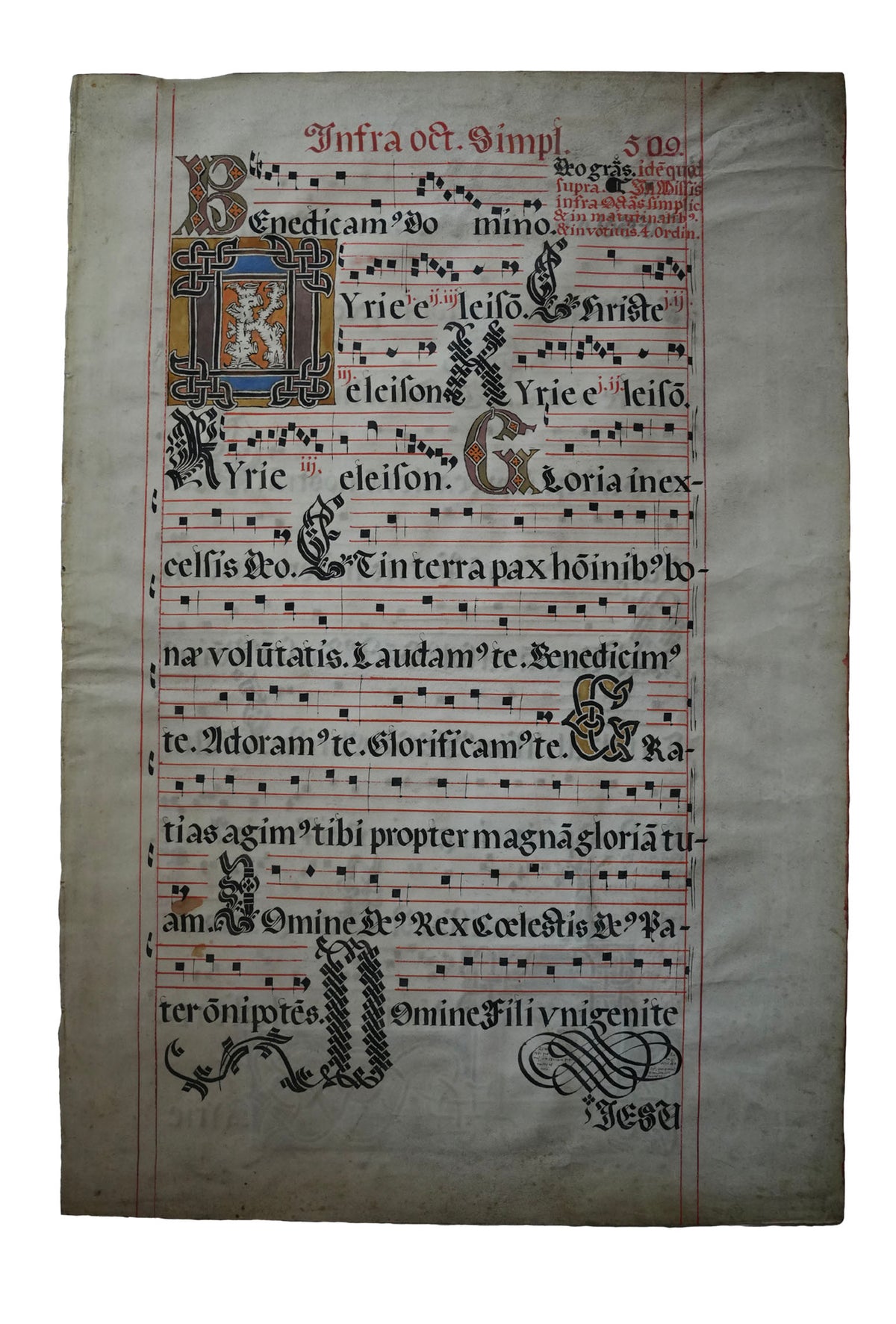
A Polish Illuminated Choirbook Leaf by Błażej Derey, Poznań, 1632
A Polish Illuminated Choirbook Leaf by Błażej Derey, Poznań, 1632
Nie można załadować gotowości do odbioru
Derey, Błażej OP (c.1587–1666).
Illuminated Kyriale, single leaf on vellum.
Poznań, Dominican convent, 1632.
Large folio.
A monumental survival from an extraordinary Polish Dominican Kyriale of 1632, here attributed to Błażej Derey, probably the most distinctive manuscript artist of seventeenth-century Poland. The parent manuscript has previously been recognised as a Kyriale made for the Dominican convent at Poznań in 1632 (cf. Bloomsbury Auctions, London, 6 July 2022, lot 59), but the now-dispersed manuscript has apparently never previously been recognised as a work of Derey.
The attribution proposed here rests upon a close conjunction of date, Dominican provenance and, above all, decorative vocabulary and has been independently supported by an expert.
Derey’s surviving manuscripts have received considerable scholarly attention. Zbigniew Mikołejko characterises his work by its subdued or “broken” palette, particularly yellows; gilded and silvered grounds; a repertoire of zoomorphic ornament which specifically includes dolphins; and, most characteristically, elaborate one-, two-, three- and four-strand interlace. All are strongly represented in the present leaf.
Particularly close comparison may be made with Derey’s Dominican liturgical manuscripts preserved in Kraków, where closely related knotwork, colouring, ornamental lettering and zoomorphic forms recur.
The chronology is equally compelling. Derey was producing major Dominican choirbooks during precisely this period: the surviving corpus includes the Supplementum of 1630 (MS 12 L), Graduale de tempore of 1632 (MS 9 L), Graduale de sanctis of 1633 (MS 11 L), and Graduale de tempore of 1635 (MS 10 L). Those manuscripts are themselves substantial folios, generally approximately 26–28 × 38–40 cm. At 41 × 60 cm, however, the present Poznań Kyriale was conceived on an altogether more monumental scale and would appear to be the largest manuscript presently attributable to Derey by a considerable margin.
Its historical setting is equally exceptional. The Kyriale was produced for the Poznań Dominicans apparently under the direction of their prior, Jacek (Hyacinth) Choryński, whose name reportedly appeared on its original frontispiece together with that of the Polish Dominican Provincial, Jerzy Trebnic.
The year 1632 marked the culmination of an important programme of artistic and devotional patronage at the Poznań convent. Under Choryński the house commissioned Tomasso Dolabella’s monumental Battle of Lepanto, now at Wawel Castle, for the Rosary Chapel. Its principal financial patron was Stanisław Przyjemski, Grand Marshal of the Crown. Aleksander Stankiewicz has argued that, while Przyjemski probably supplied the money, the learned Choryński may himself have devised the painting’s intellectual and iconographic programme; he even proposes that the Dominican friar depicted holding a book and candle may represent Choryński.
The appearance of Choryński’s name on the Kyriale’s frontispiece therefore has particular significance. Created for the same convent, in the same year, and on a similarly exceptional scale, the manuscript may plausibly have formed part of the wider programme of liturgical and artistic renewal over which he presided. It is even possible that Przyjemski, whose patronage financed the Dolabella commission, contributed towards the costly production of the Gradual, although no documentary evidence for his involvement has yet been identified.
Several leaves from the parent codex are known. Its surviving frontispiece reportedly carried a lengthy Latin inscription dating the manuscript, identifying its chant as following the Dominican edition of Seraphinus Siccus of 1620, naming Trebnic and Choryński, and recording the Poznań convent as its destination.
The parent manuscript had already been dispersed by 1966; leaves passed through the dealer Bruce Ferrini in the 1990s, while another leaf formerly in the collection of Cornelius J. Hauck, significantly trimmed, dated a century too early, and with a German catalogue entry pasted to the verso, was sold at Christie’s New York in 2006, then realising 2,280 USD.
A spectacular fragment of an apparently lost monumental choirbook from one of the great periods of artistic patronage at the Poznań Dominican convent, and, on the evidence presented here, an important addition to the known oeuvre of Błażej Derey.
Provenance
Condition
Share