A Renaissance Bible owned by a priest who saved Jews during the Holocaust
A Renaissance Bible owned by a priest who saved Jews during the Holocaust
Nie można załadować gotowości do odbioru
Biblia Latina.
Lyon: Jacques Sacon, 10 November 1506.
Folio.
The rare first Bible printed by Jacques Sacon, very extensively annotated throughout in contemporary hands, rubricated, and with remarkable later provenance to Martin Jan Vochoč, the Czech priest celebrated for helping some 1,500 Jews escape Nazi persecution.
This was the first Bible issued from the press of Jacques Sacon, probably for the Lyon bookseller Barthélemy Trot, inaugurating the important series of Latin Bibles for which Sacon became particularly celebrated and preceding by six years the first of his editions printed for Anton Koberger.
The edition has an unusually distinctive bibliographical character. In the colophon Sacon describes the book as Impressum est characteribus venetis per Iacobum Sacon, while the original title-page device closely imitated that employed by the Venetian Giunta press. The combination appears deliberately conceived to evoke the appearance and commercial prestige of Venetian, and specifically Giunta, production. The connection is particularly striking in retrospect: Giunta’s illustrated Latin Bible of 1511 subsequently furnished the principal model for the first Sacon-Koberger Bible of 1512.
The edition also belongs to an important transitional phase in the history of the printed Vulgate text, between the inherited textual traditions of the fifteenth century and the increasingly corrected and critically examined Latin Bibles of the sixteenth century. Sacon followed the Bible printed by Thielman Kerver for Jean Petit in 1504, itself a substantially corrected text associated with the editorial work of Adrianus Gummelli. The 1506 Bible thus stands at the intersection of two developments that would increasingly define biblical publishing in the new century: a more sophisticated international market for printed Scripture and a more interventionist approach to the received Latin text.
The present copy is distinguished by extensive contemporary annotation throughout virtually the entire text. Seemingly several unidentified early readers have supplied a continuous series of marginal notes, not merely occasional glosses but sustained evidence of close engagement with Scripture from beginning to end. The density and continuity of the marginalia make this an unusually substantial witness to the practical reading and study of the Bible in the first years of the sixteenth century, on the eve of the theological upheavals of the Reformation that would transform Western Christianity.
Its later provenance is no less remarkable.
On 6 December 1929 the Bible was acquired by the nineteen-year-old Martin Jan Vochoč (1910–1967) and entered as no. 2320 in his personal library. Vochoč, an archivist, historian and Old Catholic priest, would later become known as the “Czech Oskar Schindler” for his role in producing fictitious baptismal certificates for Jews attempting to escape Nazi persecution. Vochoč studied theology and archival science, worked for a time as historiographer to the Knights of Malta, and was ordained an Old Catholic priest in 1936.
During the Nazi occupation of Czechoslovakia he collaborated with the Prague lawyer Rudolf Štursa in issuing false baptismal certificates to Jews seeking to emigrate. Later research records approximately 1,500 such documents. Although that figure cannot be equated directly with an identical number of lives saved, the surviving evidence establishes that the operation enabled numerous Jews to avoid deportation to concentration camps and probable death.
His activities attracted the attention of the Gestapo. In 1941 an order was issued to search his premises and arrest him in connection with the falsification of Jewish baptismal certificates, though he was initially released for lack of evidence. He was subsequently sent, on instructions from the Reich Main Security Office (RSHA), to forced labour in Germany. At Coburg in Bavaria he worked as a clerk and contracted tuberculosis. His illness led to his release in 1944 and return to Prague, where he nevertheless remained under Gestapo surveillance and was forbidden to exercise his priestly ministry.
The precisely dated acquisition of the present Bible lends this provenance particular force. Vochoč did not acquire it retrospectively as an established priest or historian, but as a nineteen-year-old student, seven years before his ordination and almost a decade before the actions for which he would later become known. The volume consequently survives both as an intensively studied Renaissance Bible and as a tangible object from the intellectual formation of a man whose later courage placed him within one of the defining moral crises of twentieth-century Europe.
Rare. Just twelve institutional copies are presently recorded across the two USTC records for the edition, with none recorded in Poland or the United States.
Provenance
1. Extensive contemporary marginalia throughout the entire text of the Bible
2. Martin Jan Vochoč (1910–1967), acquired 6 December 1929 and entered as no. 2320 in his personal library.
3. Exported from Hungary under granted export licence from the Kulturális és Innovációs Minisztérium.
Condition
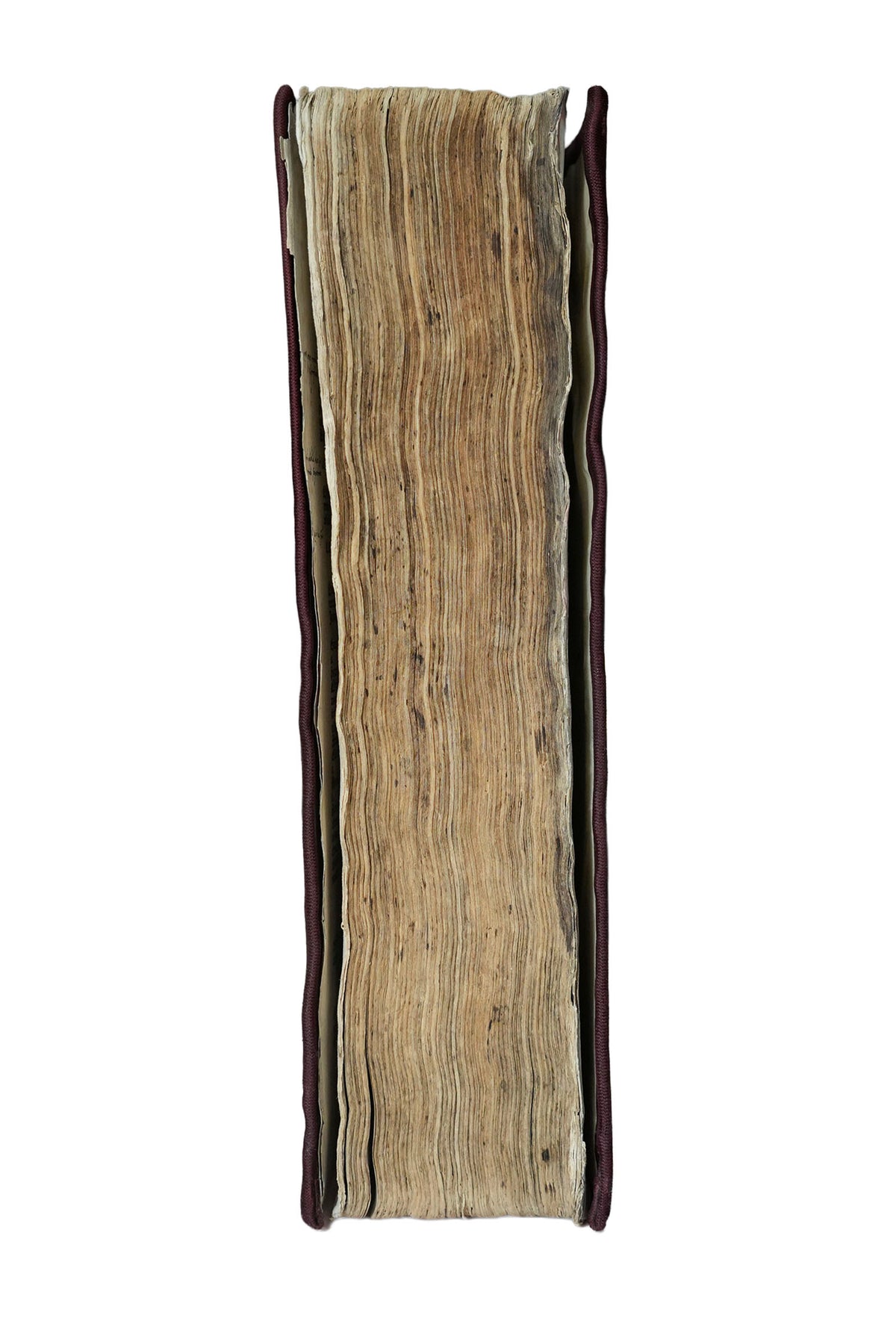
Twentieth-century full cloth with an embroidered design to the cover, plausibly associated with Vochoč’s ownership. Binding secure, externally handsome. Some slight non-uniformity of leaf edges externally.
Lacks the preliminaries (A⁸, B⁶), but the text of the Bible itself collates as complete, retaining the Prologue as well as the Interpretationes nominum Hebraicorum. Extensive contemporary marginalia throughout the full text. Handsomely rubricated in red and blue throughout. Mildly toned, a few stains, dampstaining to the final few leaves, otherwise a handsome copy with notable provenance.
USTC 143119, 812355; D&M 6091; Bibliographia Bibliorum Latinorum, no. 102; Pettegree 57246
Share