Gregory the Great’s Moralia in Job, 1498: A Late Incunable with an Ave Maria Binding
Gregory the Great’s Moralia in Job, 1498: A Late Incunable with an Ave Maria Binding
Nie można załadować gotowości do odbioru
[Gregory the Great] Sanctus Gregorius Magnus (c. 540–604).
Moralia, sive expositio in Job.
Brescia: Angelus Britannicus, 2 June 1498.
Quarto.
A handsome late medieval copy of Gregory’s Moralia, from the final incunable edition, with notable early female provenance. The binding is repaired but preserves a particularly handsome contemporary front board decorated with an intricate Ave Maria border. Gregory the Great’s Moralia in Job, composed in the late sixth century, is one of the most influential works of medieval Christian theology: a vast commentary on the Book of Job in which Gregory moves beyond literal exposition to interpret the text morally, allegorically and spiritually, exploring virtue, sin, suffering, pastoral responsibility, and the progress of the soul toward God. The work became a foundational text of medieval monastic and theological culture and circulated widely throughout the Middle Ages.
Provenance
1. Presentation inscription from a nun styled “Madre Sor Angela [de Archa?]”, perhaps a Mother Superior, to the Monastery of Santa Chiara in Porto Maurizio dated 1535; this is a nunnery founded in 1365 by the Poor Clare nuns and remains active to the modern day.
2. Extensive marginalia throughout in several hands, plausibly associated with the nuns of Santa Chiara. Some of the notes are probably post-1551 due to the use of numbered Bible verses, indicating active use in the convent library over several decades.
3. Effaced illegible ownership inscription to head of title page.
4. ‘Ex libris R Jacobi […] I.V.D’, an unidentified owner styled Iuris Utriusque Doctor (Doctor of Both Laws, i.e. civil and canon law).
5. Circa eighteenth century ownership inscription of ‘A Pietro Dom. Garasin[-] Can.’
6. Italian private ownership.
7. Exported from Italy with an export licence from the Ministero della Cultura permitting permanent export.
Condition
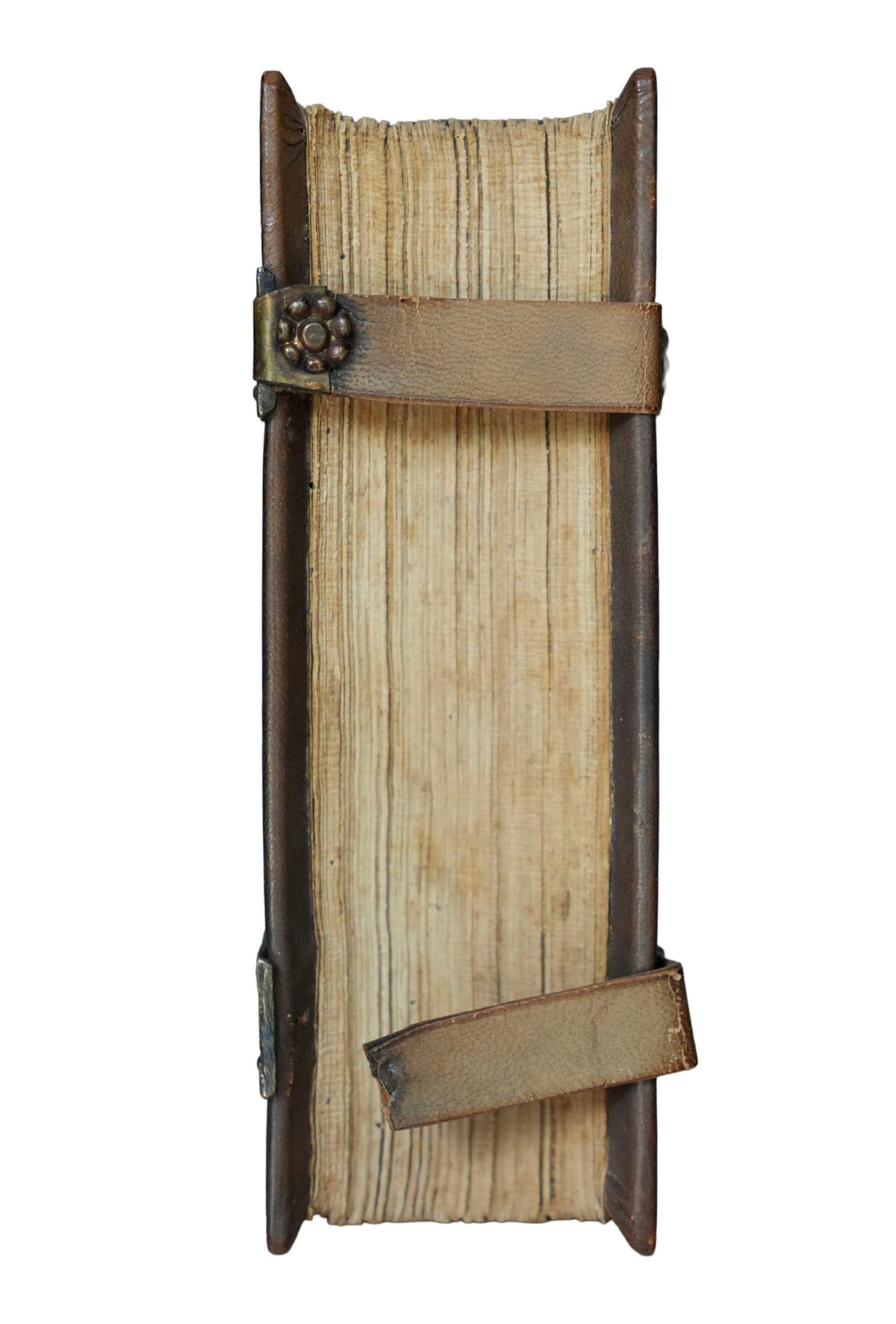
Rebound in full calf over wooden boards retaining some early metalwork including one functional clasp alongside most of the contemporary front board with an attractive Ave Maria border in blind. Spine sunned, some wear to binding, minor worming. Manuscript binder’s waste (c. 1450) employed as the front pastedown.
Textually complete, with 425 of 426 original leaves extant; wanting Z10, the original terminal blank, here replaced by a later blank. Ink ownership inscriptions to the title-leaf, some effaced; 1535 gift inscription at the foot of a1. Text block lightly toned, some leaves more heavily than others, with occasional dampstaining at the edges, heavier to the last few quires. Extensive marginal annotation throughout, some manuscript textual corrections demonstrate close consultation. Minor worming, principally confined to the margins, most prominent in the opening leaves and front blank. A number of initials have been supplied or strengthened in black ink (i.e. rubrication).
ISTC ig00434000; Copinger 2780; Bibliotheca Terrae Sanctae 54i
Share