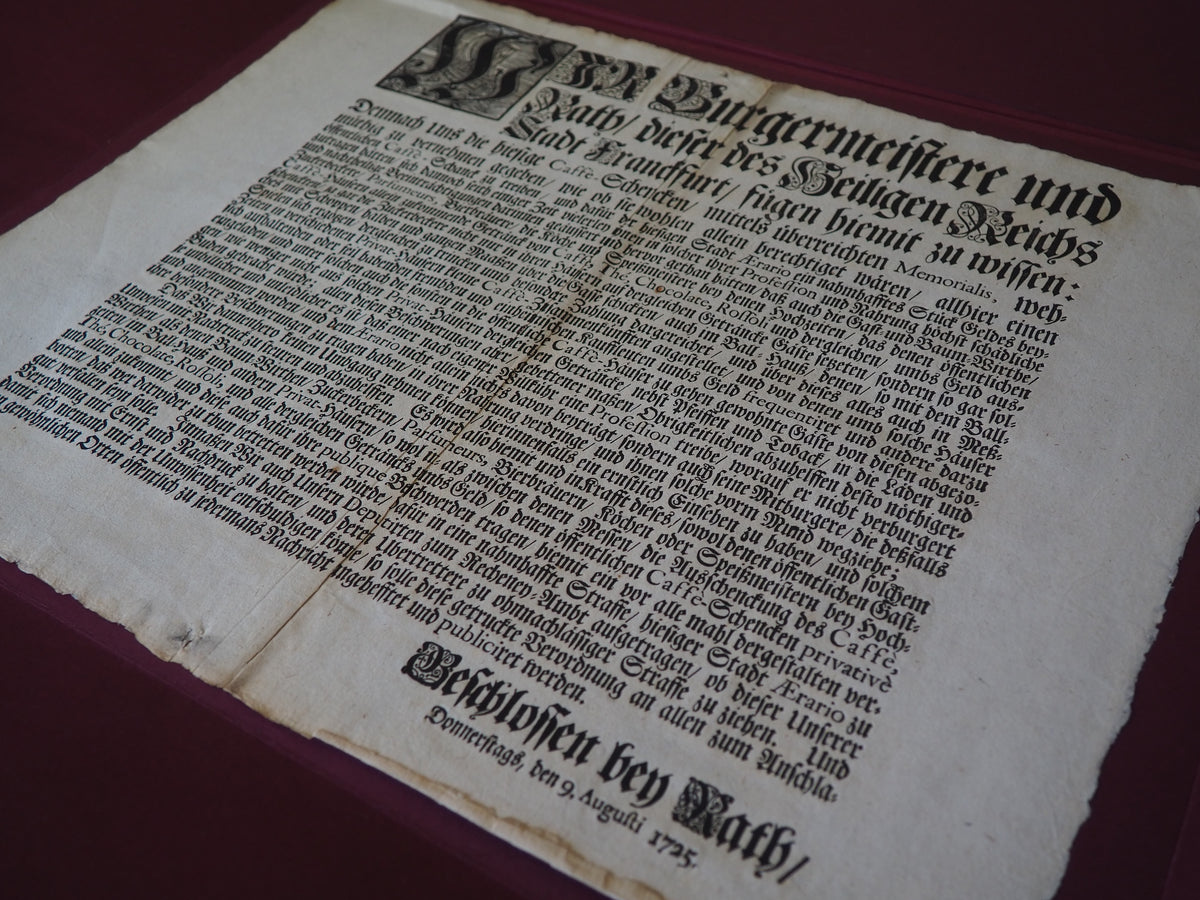
Who Could Sell Coffee? A Frankfurt Coffeehouse Broadside, 1725
Who Could Sell Coffee? A Frankfurt Coffeehouse Broadside, 1725
Couldn't load pickup availability
Municipal Broadside Edict concerning the Licensed Sale of Coffee, Tea, Chocolate, and Rosolio. Frankfurt am Main, 9 August 1725.
A rare and evocative survival from the formative age of Europe's coffeehouse culture, this municipal broadside records the efforts of the Imperial Free City of Frankfurt to regulate the sale of the newly fashionable stimulants and luxury beverages that were transforming social life across the continent.
Issued in the name of the Bürgermeistere und Rath of Frankfurt, the ordinance arose from complaints lodged by the city's licensed Caffee-Schencken, coffeehouse keepers who had purchased from the municipal authorities the exclusive right to maintain public coffee establishments. According to their petition, a growing number of traders had begun to infringe these privileges by serving coffee and other fashionable refreshments outside the authorised coffeehouses.
The edict therefore intervenes directly in the commercial life of the city, naming among the offenders innkeepers, tavern proprietors, confectioners, perfumers, brewers, cooks, and caterers, all of whom were accused of selling prohibited beverages to the public.
Particularly remarkable is the range of commodities explicitly listed. Alongside Caffè appear Thé (tea), Chocolate, and Rossoli (rosolio), the sweet Italian cordial then popular throughout Europe. The document thus preserves a vivid snapshot of the international consumer revolution of the early eighteenth century, when products imported from Asia, the Americas, and the Mediterranean were reshaping patterns of sociability, commerce, and taste.
The broadside is equally revealing as a document of urban administration. The petitioners emphasise that they alone had paid a substantial sum into the city treasury for the right to maintain public coffeehouses, and the council responds by forbidding all unauthorised sale of these beverages. What emerges is a striking example of the highly regulated commercial environment of the Holy Roman Empire, where municipal governments actively controlled the distribution of goods and defended licensed trades against competition.
Ephemeral by nature and intended for public display, such broadsides were seldom preserved. Their survival offers an unusually direct glimpse into the everyday realities of eighteenth-century urban life: the rise of coffeehouse culture, the spread of global commodities, and the mechanisms by which civic authorities sought to govern an increasingly interconnected world.
Provenance
Condition
A little worn at edges, central crease, shows well. Unframed. Accompanied by an archival case.
Share