A Renaissance Encyclopaedia of the House: Grapaldi’s De partibus aedium, 1494
A Renaissance Encyclopaedia of the House: Grapaldi’s De partibus aedium, 1494
Couldn't load pickup availability
Grapaldus, Franciscus Marius (1460–1515).
De partibus aedium.
Parma: Angelus Ugoletus, 1494.
Quarto.
No recorded copies held in Poland. This rare incunable edition presents Francesco Mario Grapaldi’s De partibus aedium, an unusual and highly engaging Renaissance treatise on the parts, contents, and management of the house. Printed at Parma by Angelus Ugoletus in 1494, it belongs to the small but important body of fifteenth-century printed works concerned with architecture, domestic space, material culture, and the recovery of classical terminology. Although modest in format, the work is intellectually ambitious: it approaches the house not merely as a building, but as a complete human, social, and learned environment.
Francesco Mario Grapaldi was a humanist from Parma, poet, antiquary, and man of letters. His De partibus aedium is his best-known work and reflects the broad encyclopaedic habits of Renaissance humanism. Drawing heavily on classical authorities, especially Latin authors concerned with architecture, natural history, agriculture, household economy, and antiquarian terminology, Grapaldi organises the domestic world into a learned survey of rooms, structures, furnishings, tools, gardens, animals, food, wine, and household practices. The result is not a technical architectural manual in the narrow Vitruvian sense, but a humanist lexicon of the house and its contents.
The work is arranged as a kind of thematic dictionary or encyclopaedia of domestic life. Grapaldi treats the various parts of the house and its surrounding spaces, including areas such as the kitchen, library, nursery, aviary, fishpond, stable, garden, and storehouse. From these architectural and domestic headings, he moves outward into discussions of the objects, materials, activities, and vocabulary associated with them. The text therefore offers valuable evidence for the Renaissance understanding of the household as a place of learning, storage, display, production, nourishment, sociability, and moral order.
Its interest extends beyond architecture. De partibus aedium is also significant for the history of lexicography, domestic economy, gastronomy, gardening, and book history. Later editions explicitly present the work as a lexicon, and its method anticipates the encyclopaedic tendency of many sixteenth-century dictionaries. Particularly notable is Grapaldi’s discussion of the library, which includes a celebrated account of papermaking. Elsewhere the work touches on food, wine, storage, household provisioning, tools, crafts, animals, and gardens, making it a rich source for the material culture of the Renaissance home.
“Contains a glossary of terms used in building, gardening, and domestic crafts; and includes an interesting tour of a house, its nursery and library, its fishpond, aviary, and stables. Relates also to architecture and gastronomy” (Stillwell). “This work was an early dictionary and probably the first to include architectural terms” (Fowler). “He describes the various foods and wines to be kept in the house, when and how to serve them, and how to avoid waste and excess” (Simon).
The 1494 Parma edition is the first edition of the work and its only incunable printing. It was followed by a series of sixteenth-century editions, including revised and expanded forms, which testify to the continued usefulness and appeal of the text. It is rare. ISTC records forty holding institutions, with no copies recorded in Poland and only two in Germany. As a result, this edition is desirable not only as an early printed architectural and antiquarian text, but also as a witness to the humanist attempt to order the material world of the house through classical language and learned classification.
1. Giovanni Battista del Giudice, probably of the Del Giudice family of Chieti/Casalincontrada, later Marchesi di Casalincontrada, circa 1699–1720; inscription: “Ex libris marchionij dn. Joannis Bapti[st]e del Giudicej”. Not to be confused with the Italian Catholic prelate of the same name (d. 1542).
2. Carolus Antinori, Parma, Italy, with book-label/book sticker of the Alma Bibliotheca Caroli Antinori.
3. Exported from Italy under granted export licence.
Condition
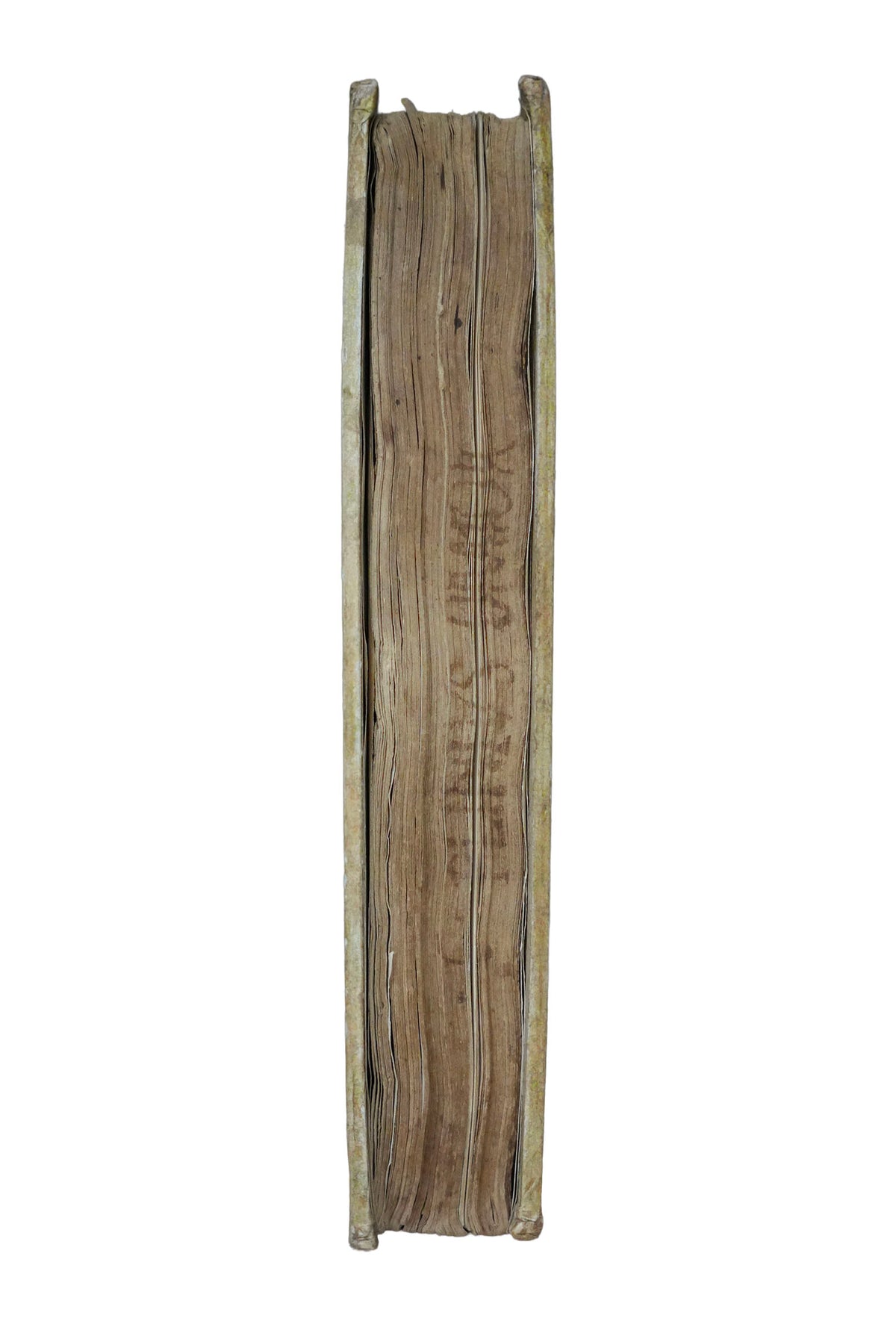
Later vellum, rebacked, a little rubbed, but well presented. Erroneous early manuscript title to foreedge, falsely attributing the work to Pliny. Late-twentieth-century Italian book-sticker to upper pastedown; later blanks. The exemplar collations do not call for original blanks (cf. ISTC, GW, et al.).
Gathering l (L) in notably high-quality facsimile; otherwise collates as complete. Ex libris inscription to a1r. a1–2 repaired at leaf edges; a few other leaves with minor edge loss, without loss of text. e3–6 slightly loose at the foot but extant.
Minor staining to a few leaves, mildly toned, else generally bright and clean throughout, with margins generally well preserved. Final 3 pp. slightly foxed. Final page (q6v, blank) with near-contemporary inscriptions, including a mirrored ink trace of the printer’s device.
Goff G-349; ISTC ig00349000; Bod-inc G-171; Sheppard 5681; Pr 6870; BMC VII, 945; GW 11331; Fowler 141; Simon, Bacchica I, 142; Stillwell, Awakening VI, 846
Share