Antoni Kątski: An Unpublished Autograph Piano Composition, 1852
Couldn't load pickup availability
Kątski, Antoni [Antoine de Kontski] (1816–1899).
L'Adieu.
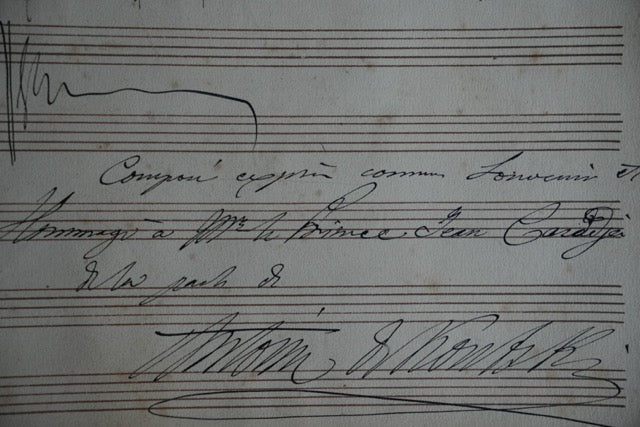
Autograph musical manuscript signed, a complete composition for piano written expressly for Prince Jean Caradja.
Berlin, 29 May 1852.
A complete manuscript musical composition by the prominent Polish pianist and composer Antoni Kątski, written during his years at the Prussian court. No autograph musical manuscripts by Kątski are recorded in Polish institutional collections. Far more substantial than the brief musical quotations through which Kątski is represented in several surviving private and institutional collections worldwide, the present manuscript preserves a finished work from first bar to final cadence, fully signed, dated and explicitly described by the composer as “Composé exprès” for its recipient. It places a major Polish musician moving through the cultural world of the Great Emigration directly within the courtly and diplomatic networks of Berlin.
The manuscript consists of one leaf of ruled music paper, entirely in Kątski's hand, headed L'Adieu and Moderato. The piano miniature is written throughout with dynamics, articulation and expressive markings and concludes with a full cadence. Beneath it, Kątski records the circumstances of its creation: “Composé exprès comme Souvenir et Hommage à Mr le Prince Jean Caradja. De la part de Antoine de Kontski,” dated Berlin, le 29 Mai 1852.
Its completeness is important. The Morgan Library & Museum preserves another Kątski musical autograph written in Berlin only the previous year, but that manuscript consists of just five measures presented to the violinist Leopold Ganz. Here Kątski did something quite different by composing and presenting an entire work.
The date of this composition is quite interesting. Between 1851 and 1853 Kątski was established in Berlin, attached to the Prussian court and teaching Princess Louise of Prussia. He had arrived there after more than a decade in Paris, where his career had developed within the cultural world of the Great Emigration. His circle included Adam
Mickiewicz and Fryderyk Chopin, and on 26 May 1845 he performed with Chopin at the Hôtel Lambert, the Czartoryski residence which had become one of the principal political and cultural centres of Polish exile.
Only seven years later, he is at the Prussian court. That movement from Hôtel Lambert to Berlin gives the manuscript significance beyond the biography of a single composer. It documents the wider European history of Polish culture after the November Uprising, when musicians, writers and intellectuals carried the intellectual and artistic world of the Great Emigration into German courts, salons, publishing centres and diplomatic circles. Poland had disappeared from the political map, yet Polish cultural life remained intensely present across Europe.
Kątski is one of the clearest musical embodiments of that history. Born in Kraków, established in émigré Paris, associated with Mickiewicz and Chopin, he subsequently entered Prussian royal society before continuing an international career across Russia,
Western Europe, Asia, Australasia and America. The present manuscript belongs precisely to the German phase of that trajectory and offers immediate evidence of Polish-German cultural relations during the age of the partitions.
Its recipient places that relationship within an even wider European network. Prince Jean Constantin Alexandre Othon Caradja (1835–1894), later Karadja Pasha, was a member of the distinguished Phanariot Caradja family and would become an Ottoman diplomat, officer as well as a pianist and composer himself. In May 1852, he was living within the Berlin household of his father, Prince Constantin Caradja, then Ottoman envoy to Prussia.
The musical dedication was part of an established Caradja culture of collecting composers' manuscripts. In the same summer of 1852, Giacomo Meyerbeer wrote a substantial 34-bar musical manuscript in Berlin “Pour l'Album de Monseigneur le Prince Caradja” for Jean's father Constantin. Jean himself continued to receive musical manuscripts over subsequent decades, including contributions by August Faubel in 1856, Charles Gounod in 1869
and Jules Massenet in 1888. Kątski's L'Adieu therefore survives from a particularly well-defined social world. A Polish composer associated with Chopin, Mickiewicz and the Hôtel Lambert, now attached to the Prussian court, writes a complete work for the son of the Ottoman envoy, within a household simultaneously attracting musical manuscripts from Meyerbeer.
This manuscript may contain a further discovery. Kątski had already published a piece entitled L'Adieu as no. 6 of his Impressions de voyage, Op. 83, by 1845. The shared title does not establish identity. Kątski demonstrably reused titles for different compositions. Jeremiusz Glensk's complete autograph La Resignation, written in Paris in 1843, bears the same title as Kątski's later published La Résignation, Op. 131, yet Glensk notes that the printed piece “w żadnym razie nie przypomina” the earlier manuscript.
Kątski's own inscription here is correspondingly significant. He states that this L'Adieu was “Composé exprès”, composed expressly, for Prince Caradja. Comparison with the rare printed Op. 83 no. 6 remains necessary, but there are strong grounds for treating the present manuscript as a distinct composition until that comparison proves otherwise. If the music differs as seems most likely, it would establish L'Adieu as an otherwise unrecorded and unpublished work by Kątski. No copy of Op. 83 no. 6 has yet been located for comparison; the edition itself appears to be scarce. Nonetheless, the available evidence suggests that the present manuscript is an unpublished composition.
The survival of Kątski's autograph music has itself been surprisingly little studied, probably due to its absence from Polish institutional collections. In his 2025 article “Muzyczne galicjana w kolekcji Ewy i Jeremiusza Glensków,” Jeremiusz Glensk, discussing the complete 1843 autograph of La Resignation in his own collection, stated “w krajowych, publicznych zbiorach brak jest jakichkolwiek autografów muzycznych tego kompozytora” and referred to “zaledwie trzy pozycje” (just three known examples) in library and museum collections internationally.
Further research allows Glensk's worldwide census to be expanded. The Russian National Museum of Music records twenty autograph musical manuscripts by Kątski, largely from the later Russian period of his career, while further examples are preserved at the Morgan Library & Museum, Bibliothèque nationale de France and Library of Congress. His central Polish observation remains the more consequential one: recent specialist scholarshiprecords no autograph musical manuscript by Kątski in a Polish public collection and our research also could not locate any recorded in Polish institutional collections.
That absence is particularly striking given Kątski's place in nineteenth-century Polish cultural history. His manuscripts survive abroad because his career itself unfolded abroad, across the same European networks created and sustained by a stateless Polish elite after the partitions. L'Adieu is a concentrated survival from that world: a complete composition, rather than a quotation; written during Kątski's Prussian court period; addressed to a named diplomatic recipient; and connected directly backwards to the Polish émigré milieu of Paris and the Hôtel Lambert.
The manuscript consequently speaks to several histories at once: Polish music, the Great Emigration, Polish-German cultural relations, the international circulation of Polish artists, Prussian court culture and nineteenthcentury European diplomacy. Few Kątski manuscripts bring those strands together so clearly, and fewer still preserve a complete musical work.
Condition
Jeremiusz Glensk, “Muzyczne galicjana w kolekcji Ewy i Jeremiusza Glensków,” Musica Galiciana. Kultura muzyczna Galicji w kontekście stosunków polsko-ukraińskich, XIX (2025), pp. 84–94, especially pp. 90–
91.
Share