Medieval Money, Luxury and Marriage: An Illuminated Medieval Manuscript of St Bernardino of Siena, 1466
Medieval Money, Luxury and Marriage: An Illuminated Medieval Manuscript of St Bernardino of Siena, 1466
Couldn't load pickup availability
Medieval Economics, Female Luxury and Marriage
Saint Bernardino of Siena (1380–1444); Saint Antoninus of Florence (1389–1459); Giovanni d’Andrea (c. 1270–1348); anonymous.
Tractatus de restitutionibus; Excerpta ex tractatu de restitutionibus; Tractatus de contractibus et usuris; Tractatus de ornatu mulierum; Tractatus de sponsalibus et matrimonio; Casus.
Northern Italy, probably Lombardy, perhaps Brescia, c. 1450–1466; the second scribal unit explicitly dated 18 September 1466.
Illuminated manuscript on parchment. Quarto (173 × 245 mm).
Saint Bernardino of Siena, acclaimed by Pope Pius II as “another Paul” and revered as the “Apostle of Italy,” was the most powerful Italian preacher of the fifteenth century and the great moral intelligence of Europe’s emerging commercial order. This complete illuminated manuscript on parchment brings together his monumental treatises on restitution, contracts and usury, themselves an innovative analysis of property, credit, price, capital, profit and the authority of the merchant, with an extraordinary sequence of texts on women’s luxury, betrothal and marriage, following the life of wealth from the international marketplace into female fashion, jewellery, dowry, inheritance and the legal constitution of the family.
Preserved intact and complete, with contemporary annotation and a concluding legal Casus, and subsequently housed in the celebrated Minutoli-Tegrimi Library, this codex is a commanding witness to the moment when money, female consumption and marriage were drawn together into a single system of European social thought. In Poland, where Bernardino’s name became attached to an entire cultural-religious movement, its resonance is exceptional.
Bernardino’s influence rested on the extraordinary reach of his preaching. For more than three decades he moved through the cities of Italy, addressing merchants, magistrates and crowded civic audiences on the moral dangers of rapid commercial expansion. Usury, fraudulent exchange, manipulated prices, conspicuous consumption and the dissipation of family wealth were not peripheral concerns in his sermons but central disorders of the Christian commonwealth, and his campaigns could reshape public behaviour on a dramatic scale: luxury goods and objects of vanity were surrendered and destroyed in scenes that anticipate, and indeed originated, the tradition later made famous by Savonarola’s bonfire of the vanities.
The organisation of the manuscript is especially revealing of its purpose. Bernardino’s Tractatus de restitutionibus occupies ff. 1r–37v. It is not followed immediately by his great Tractatus de contractibus et usuris, but instead by ten folios explicitly identified by the scribe as extracts from a treatise on restitution by the Dominican Antoninus of Florence, “extracta sunt de tractatu quem de restitutionibus edidit … frater Antoninus de Florentia sacri ordinis Predicatorum” (ff. 38r–48r), before the manuscript returns to Bernardino’s De contractibus et usuris on f. 48r, continuing to f. 92r.
Antoninus, a Dominican friar and archbishop of Florence, is thus deliberately inserted between Bernardino’s two major economic texts as a second authority on the same moral and economic problem. This is therefore a compendium consciously assembled to bring Franciscan and Dominican moral theology into direct dialogue over the ethics of commercial life, significantly before modern scholarship arrived at the same pairing.
No other manuscript preserving this particular sequence of texts has been identified: the present codex appears to be the unique surviving witness to this precise conjunction of Bernardino, Antoninus and Johannes Andreae, moving from restitution and commercial ethics through female luxury to betrothal and marriage. One very close but distinct parallel is Cuomo MS 1.7.23; another is Biblioteca Comunale Teresiana MS 17. Thematically similar manuscripts include Vat. lat. 7698 and Society of Antiquaries, London, MS 335.
Bernardino’s Tractatus de contractibus et usuris then carries that enquiry across contracts, lending, exchange, price, risk and legitimate commercial profit. Bernardino did not condemn commerce as such: his purpose was to define the conditions under which profit, credit and exchange could operate justly, recognising legitimate recompense for labour, expertise and risk: an analysis of value, scarcity and entrepreneurial judgement now ranked among the most sophisticated achievements of scholastic economic thought, arrived at centuries before political economy existed as an independent discipline.
At f. 93r a second contemporary scribe begins Antoninus’s De ornatu mulierum: “Queritur primo utrum ornatus mulierum secundum morem patrie qui videtur vanus et superfluus…,” a text that arose from a genuine economic and pastoral controversy: an Observant Franciscan had denied absolution to an artisan who made fashionable women’s clothing and accessories, and the case was referred for authoritative judgment, prompting Antoninus’s discussion of the moral responsibility surrounding the manufacture, sale and use of female ornament, a controversy Thomas Izbicki dates to 1439–40.
Its placement after the treatise on contracts and usury is deliberate and significant: having examined the justice of economic acquisition and exchange, the manuscript turns to one of the most conspicuous forms in which wealth was converted into social display: clothing and personal ornament. Capital drawn from the household into fashion and jewellery drove dowries upward and distorted marriage prospects, giving luxury the character of a genuine economic force rather than a mere moral failing.
The same scribe continues at f. 96v with Johannes Andreae’s Summula super quarto libro Decretalium de sponsalibus et matrimonio, a compact treatment of the fourth book of Gregory IX’s Decretales, concerned with betrothal and marriage, by the greatest canonist of the early fourteenth century. The manuscript’s own rubric makes the transition explicit: the fourth book concerns “de sacramento coniugii quod pertinet ad laicos,” divided into sponsalia and matrimonium.
The final text thus changes discipline as well as subject: moral theology gives way to canon law, and the discussion carries the questions of wealth, consumption and household formation developed across the preceding texts into the juridical structures that actually governed engagement and marriage. The text ends on f. 99r with a dated explicit: “Explicit utilissimus tractatellus de sponsalibus et matrimonio. 1466 18 Septemb.” A short legal Casus, in a distinct third hand, follows on the same folio, evidence that, alongside the contemporary marginal notes, this handsome book was put to practical use as soon as it was made.
Restitution, contract, consumption, dowry and marriage thus appear here as successive stages in a single, coherent government of wealth, an intellectual arc of exceptional range across economic, social and gender history, conceived as one unified book rather than assembled from unrelated sermons.
The manuscript was copied at a hinge moment in transmission: its dated section was completed on 18 September 1466, at the very beginning of Italian printing, the first book printed in Italy having appeared only in late 1465, and well before any of its texts achieved stable printed circulation: Johannes Andreae’s text appeared in print only around 1472–74, Antoninus’s Titulus de restitutionibus in 1473, Bernardino’s De contractibus et usuris no later than 1474, and Antoninus’s De ornatu only later still, within the printed Summa theologica.
Bernardino appears throughout simply as frater Bernardinus de Senis, rather than beatus or sanctus, suggesting the manuscript preserves an early recension close to or within his lifetime. He died in 1444 and was canonised in 1450. The principal Bernardino and Antoninus texts most probably predate the appended 1466 text and can broadly be assigned to the third quarter of the fifteenth century, c. 1450–1475, and so may be within the lifetime of Antoninus of Florence (d. 1459), who is referred to in the present manuscript simply as venerabilis pater frater Antoninus de Florentia, sacri ordinis Praedicatorum.
Similar dated manuscripts of Bernardino in institutional collections are typically assignable to c. 1440–1460; the present example is probably towards the middle to end of that range. It is among the earliest extant witnesses.
Bernardino of Siena and Poland
Bernardino never visited Poland, but his spiritual legacy became deeply embedded there. His disciple Saint John of Capistrano founded the first Polish Bernardine house at Kraków in 1454, and the Observant Franciscan movement it launched grew into one of the largest and most culturally influential religious communities in the Polish-Lithuanian Commonwealth, prized for vernacular preaching and popular devotion.
Blessed Władysław of Gielniów, author of some of the earliest surviving Polish religious poetry, was among its most important figures, and Bernardine friars became fixtures of Polish literary memory: Father Robak in Mickiewicz’s Pan Tadeusz and Father Piotr in Dziady are among the most celebrated. The Bernardine Sisters, descended from late-medieval Polish communities of Franciscan tertiaries, form the earliest female religious congregation of native Polish origin.
Against this background the present manuscript’s significance in Poland is considerable. No pre-1500 manuscript of this collection of Bernardino’s treatises is presently recorded in any Polish collection. Several medieval Bernardino codices formerly in the Biblioteka Narodowa, including a manuscript of De contractibus et usuris (Lat.O.ch.II.19) and three further witnesses (Lat.O.ch.I.19; Lat.O.ch.I.29; Lat.Q.ch.I.131), were destroyed during the Second World War.
Today only two different fifteenth-century Bernardino manuscripts are recorded in Polish collections, both at the University Library in Wrocław (Mss. I F 293 and 1990/I), and neither approaches the present codex in richness of illumination or overall presentation.
This survey draws on Manuscripta.pl, the University of Wrocław Digital Library, the Dolnośląska Biblioteka Cyfrowa, the Biblioteka Narodowa catalogue, POLONA, NUKAT, the Federacja Bibliotek Cyfrowych, the Jagiellonian Digital Library, the Princes Czartoryski Library’s digital catalogues, and the published Codices deperditi catalogue of the National Library’s wartime losses; the same 2017–2023 Manuscripta.pl census located only three complete medieval codices anywhere in private Polish ownership.
Contents
ff. 1r–37v Bernardino of Siena, Tractatus de restitutionibus
ff. 38r–48r Antoninus of Florence, extracts from a Tractatus de restitutionibus. Rubric: “Inserta de multis recollecta extracta sunt de tractatu quem de restitutionibus edidit … frater Antoninus de Florentia sacri ordinis Predicatorum”; explicit similarly identifies Antoninus
ff. 48r–92r Bernardino of Siena, Tractatus de contractibus et usuris. Incipit: “Incipit tractatus de contractibus usurariis editus per venerabilem patrem fratrem Bernardinum de Senis ordinis fratrum Minorum”
ff. 93r–96r Antoninus of Florence, De ornatu mulierum. Incipit: “Queritur primo utrum ornatus mulierum secundum morem patrie qui videtur vanus et superfluus…”; explicit: “Explicit tractatulus pulcher … et utilis de ornatu mulierum. Deo gratias”
ff. 96v–99r Johannes Andreae, Summula super quarto libro Decretalium de sponsalibus et matrimonio. Dated explicit: 18 September 1466
f. 99r Anonymous, Casus, in a third hand, presumably of the first owner
ff. 99v–102v Original ruled blanks belonging to the Casus section.
A near-contemporary contents list within the manuscript preserves the same conception of the book, which, together with the continuous foliation, confirms that the texts were already understood as a single anthology at an early date.
- Probably produced without a specific commissioner, with the illuminated gold shield intentionally left blank for the purchaser’s arms.
- Contemporary marginalia, foliation and the contents list demonstrate that the present grouping of texts has almost certainly remained intact since the fifteenth century.
- Probably produced in Brescia on stylistic grounds, or more broadly in Lombardy. This attribution is supported by the concluding Casus, which refers to an Antonius de Prandis, plausibly connected with a document drawn up at Chiari, near Brescia, on 7 September 1467 naming Christoforus filius Antonii de Prandis as testamentary curator (Archivio Storico Comunale di Chiari, Emptio [...], no. 240, FBMPR, Pergamena no. 155).
- Stamp of the celebrated Minutoli-Tegrimi Library, the distinguished Lucchese noble collection dispersed en bloc in Florence in 1872 by Franchi & Co. Many of its manuscripts are now preserved in major institutional libraries. The Beinecke Rare Book & Manuscript Library notes that this ownership stamp “suggest[s] it may have belonged to this family as early as the 15th century” (Marston MS 55). The Jagiellonian Library likewise states that the Minutoli-Tegrimi collection originated with the Lucchese humanist Niccolò Tegrimi (1448–1527), permitting manuscripts bearing the same stamp to be traced to the library from the late fifteenth century (Sosnowski, Rzepka & Tylus, 2012, p. 32).
If so, the present manuscript may have entered the library during Niccolò Tegrimi’s lifetime, making him the earliest identifiable owner, though probably not its original commissioner. The rarity of Minutoli-Tegrimi manuscripts in private hands is demonstrated by the very small number to have appeared on the market in recent decades, including two similarly dated Augustinian manuscripts offered by Jonathan A. Hill (2015; US$270 000 and US$375 000) and a c. 1400 alchemical manuscript offered by Inlibris (€350 000), all bearing the same ownership stamp. Another codex of Bernardino from the same collection is now held in an American institutional collection.
5. Probably acquired by the Ugurgieri family from the Minutoli-Tegrimi collection, with their late nineteenth-century binding and later bookplate of Count Ruggero Grottanelli Ugurgieri of Siena.
6. Exported from Italy under licence issued by the Ministero della Cultura, permitting its permanent export.
Condition
The main text numbered in the upper outer corner of the rectos by a contemporary hand. Written on parchment in two columns in a highly disciplined Gothic rotunda, the concluding Tractatus de sponsalibus et de matrimonio copied in a distinct and looser contemporary hand, with correspondingly different rubrication.
The text is articulated throughout by alternating red and blue paragraph marks, rubricated headings and chapter divisions, and occasional pen-flourished initials. The opening leaf is distinguished by a finely illuminated lower border centred on a blank burnished-gold heraldic shield, intended for the arms of its purchaser, enclosed within concentric red, green and gold roundels and extended into delicate scrolling foliage with blue flowers, coloured buds and gold bezants.
Some worming to the opening leaf, minor effacement in places, a few stains/toned sections, early sewn repairs, otherwise generally fresh and bright.
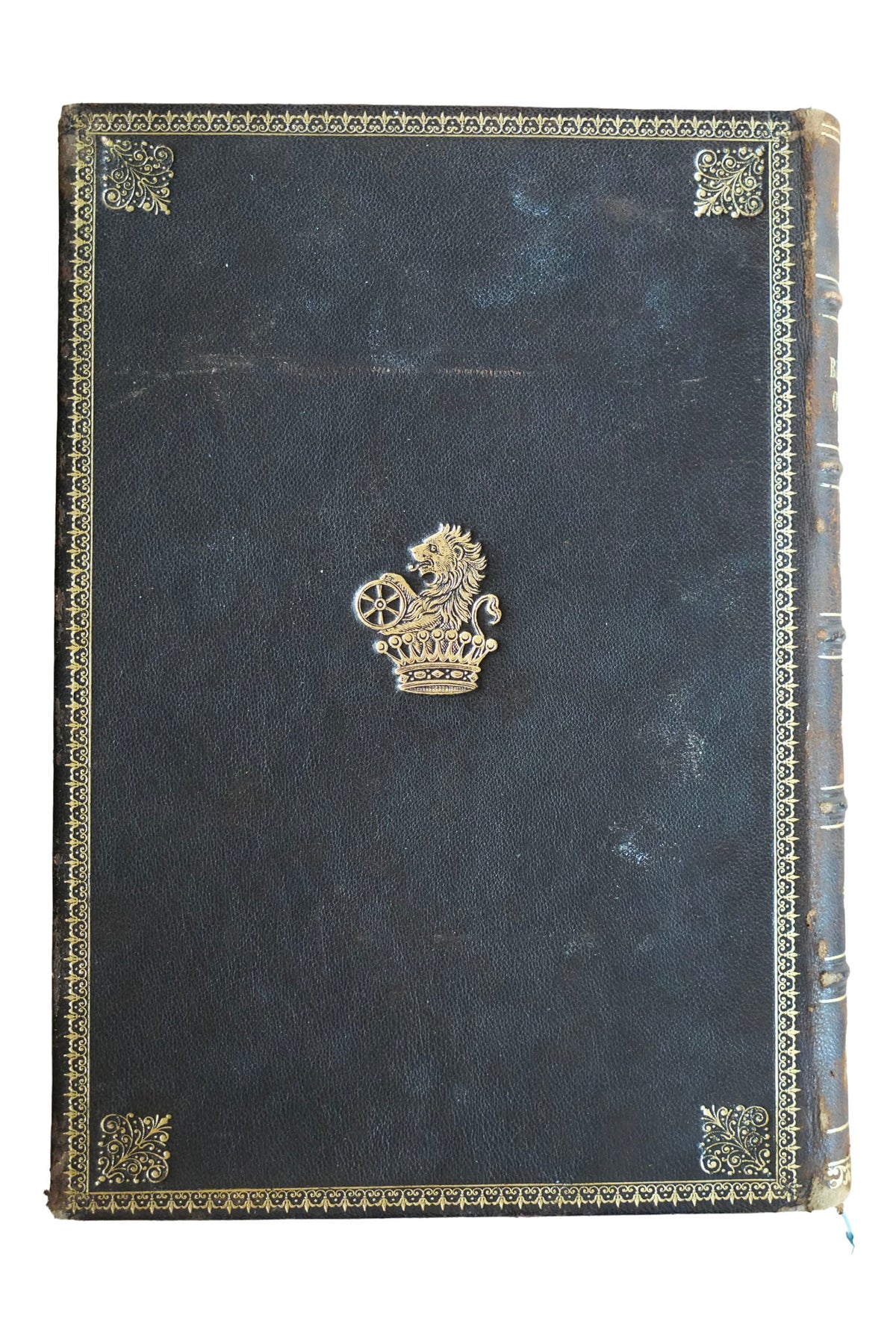
Late nineteenth- or early twentieth-century full calf, the covers centred with a gilt supralibros of a rampant lion associated with the Ugurgieri family. The date “1416” is lettered in gilt at the foot of the spine, evidently an erroneous misreading of the partially effaced colophon of the final text in the second hand; the Antoninus text De ornatu mulierum in the same scribal hand as the dated text was composed around 1440.
Binding secure, with both boards firmly attached, hinges cracked; spine slightly sunned, minor rubbing and light shelf wear. Attractive.
Bongi, Salvatore. Catalogo dei codici manoscritti posseduti dal nobile signore conte Eugenio Minutoli Tegrimi. Lucca: Tipografia Giusti, 1871.
de Roover, Raymond. San Bernardino of Siena and Sant’Antonino of Florence: The Two Great Economic Thinkers of the Middle Ages. Boston: Baker Library, Harvard Graduate School of Business Administration, 1967.
Hill, Jonathan A. Fine & Important: Catalogue Two Hundred & Thirteen. Manuscripts & Printed Books. New York: Jonathan A. Hill, Bookseller, 2015.
Pacetti, Dionisio. “Gli scritti di San Bernardino.” In San Bernardino da Siena: Saggi e ricerche pubblicati nel quinto centenario della morte (1444–1944). Milan: Vita e Pensiero, 1945.
Robinson, Paschal. “St. Bernardine of Siena.” In The Catholic Encyclopedia. New York: Robert Appleton Company, 1907.
Rothbard, Murray N. Economic Thought Before Adam Smith: An Austrian Perspective on the History of Economic Thought. Vol. 1. Auburn, AL: Ludwig von Mises Institute, 2009 (cf. “The Worldly Ascetic”).
Sosnowski, Roman, Anna Rzepka, and Piotr Tylus. The History of the Collection of Romance Manuscripts from the Former Preussische Staatsbibliothek zu Berlin, Kept at the Jagiellonian Library in Kraków: The Overall Study. 2nd rev. and expanded ed. Kraków: Faculty of Philology, Jagiellonian University, 2012 (cf. p. 32).
Note storico-istituzionali sul Comune di Chiari. Chiari: Archivio Storico Comunale di Chiari, Sistema Bibliotecario Sud Ovest Bresciano, n.d. (see no. 240, “Emptio [...]”, 7 September 1467, FBMPR, Pergamena no. 155).
Share