Duns Scotus on Creation, Free Will and the Human Soul, Venice, 1481
Duns Scotus on Creation, Free Will and the Human Soul, Venice, 1481
Couldn't load pickup availability
Duns Scotus, Johannes [John Duns Scotus] (c. 1265–1308).
Quaestiones in quattuor libros Sententiarum Petri Lombardi. [Pars II].
Venice: Johannes Herbort, de Seligenstadt, for Johannes de Colonia,
Nicolaus Jenson et Socii, 22 November 1481.
Folio.
This incunable edition preserves Part II of John Duns Scotus’ great scholastic commentary on the Sentences of Peter Lombard, the central theological textbook of the medieval schools. Printed at Venice by Johannes Herbort of Seligenstadt for the important partnership of Johannes de Colonia, Nicolaus Jenson, and associates, the edition belongs to the mature phase of Venetian incunable printing, when the major monuments of scholastic theology were being transferred from manuscript circulation into substantial printed folios for use by universities, religious houses, and learned readers.
John Duns Scotus, the “Subtle Doctor”, was one of the most important philosophers and theologians of the later Middle Ages. Born in Scotland around 1265/6, he entered the Franciscan order and taught at Oxford, Paris, and Cologne, where he died in 1308. His work exercised a profound influence on late medieval and early modern theology, especially within the Franciscan intellectual tradition.
Scotus is particularly associated with his rigorous analysis of metaphysics, individuation, divine freedom, the will, cognition, contingency, and the Immaculate Conception. His subtle distinctions and technical precision made him one of the defining scholastic thinkers of the thirteenth and fourteenth centuries.
The Quaestiones in quattuor libros Sententiarum Petri Lombardi represents Scotus’ engagement with Peter Lombard’s four-book Sentences, the standard framework through which medieval theologians treated the whole body of Christian doctrine.
Part II corresponds to the second book of the Sentences, traditionally concerned with creation and the created order. It includes discussions of God as creator, the nature of angels, the structure of the created world, the human soul, free will, sin, grace, and the Fall. In this part, Scotus’ characteristic concerns with contingency, causality, individuation, and the relation between divine and created freedom are especially prominent.
As a separate surviving part, this volume is significant both textually and bibliographically. The 1481 edition was issued in four parts, and surviving copies are often fragmentary, incomplete, or dispersed between institutions. Part II is especially desirable because it contains some of the most philosophically substantial material in Scotus’ commentary, including questions bearing directly on metaphysics, anthropology, angelology, and moral responsibility.
It therefore has value not merely as a component of a larger four-part set, but as an important scholastic text in its own right.
ISTC records four copies held in Polish institutions: a complete set at the Biblioteka Jagiellońska; Part IV only at Opole, Wyższe Międzydiecezjalne Seminarium Duchowne w Opolu; an imperfect Part I only at Warsaw, Metropolitan Seminary; and an imperfect set at Wrocław, Biblioteka Uniwersytecka.
This is representative of the wider state of survival, with copies remarkably fragmented across institutions: of the 216 copies represented by the 195 entries in ISTC, only just over half, 118, include Part II, and just 68 are complete sets; a large number of these complete sets also appear to be composite or married sets.
The present copy therefore offers an attractive opportunity either to unite dispersed parts or complete a set, while remaining a significant individual work in its own right.
1.
Recent British collection
Condition
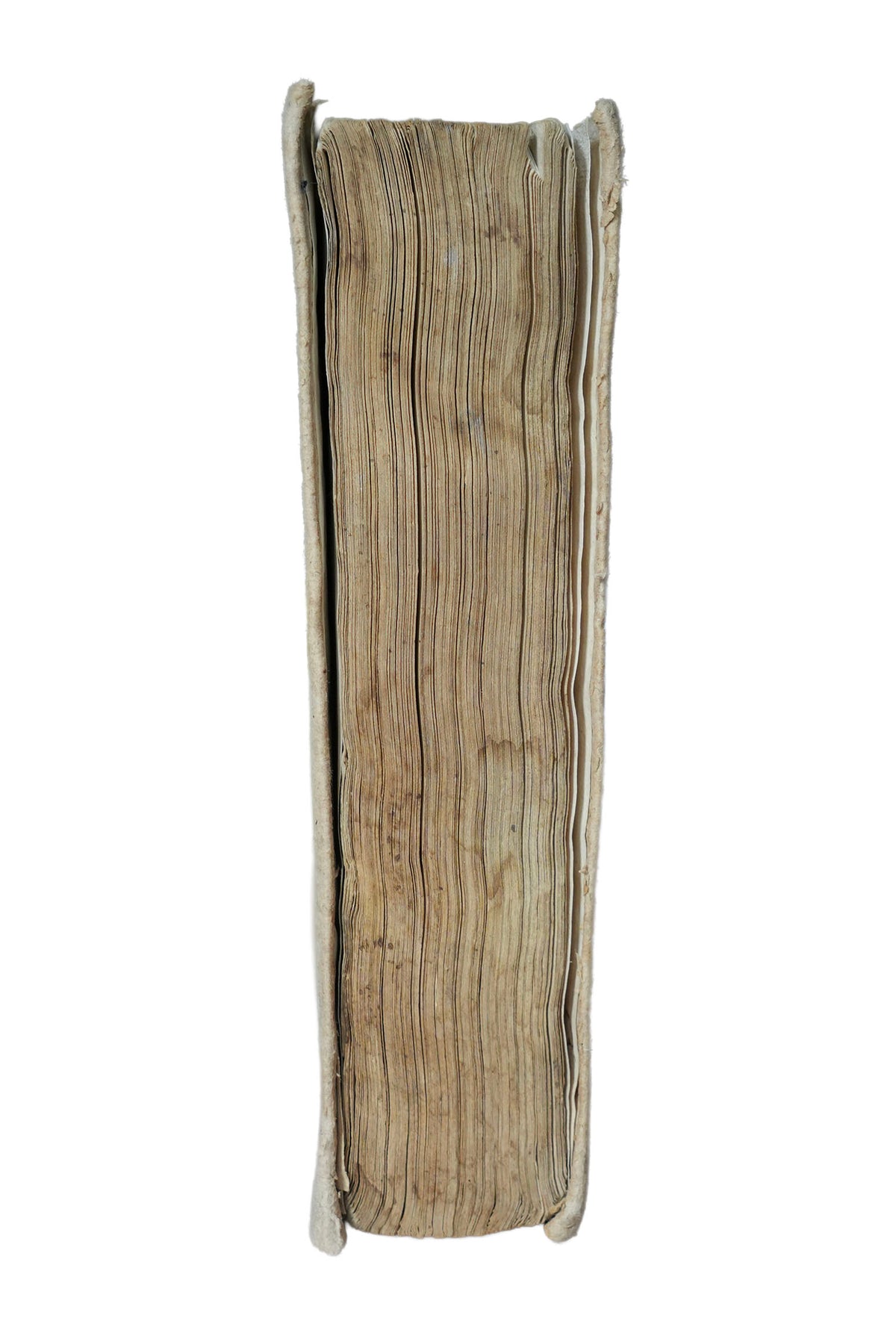
Text complete, lacking only a1, the initial blank. The text block is very clean, sporadically foxed, printed with 45 lines and headline, double column, preserving wide margins. Light dampstaining to edges throughout, most prominently at the start and rear of the text block, but presents well. Quarter vellum binding over pasteboards with an ink title. Behind parts of the ink title there are visible faded letters, perhaps of another title, thus possibly a remboîtage. Orange discolouration to a portion of the spine, appearing to be old glue used for a now wanting label. Minor wormholing to the newer, circa eighteenth century pastedowns.
Goff D381; ISTC id00381000; GW 09075; BSB-Ink D-305; Bod-inc D-168; BMC V, 302; Pell 4453; HC6418; Pr 4683-4
Share