Seneca on Stoicism, Life and Virtue: A Venetian Incunable of 1492
Seneca on Stoicism, Life and Virtue: A Venetian Incunable of 1492
Couldn't load pickup availability
Seneca, Lucius Annaeus [Seneca] (c. 4 BCE–65 CE).
Opera philosophica et epistolae.
Venice: Bernardinus de Choris, de Cremona, 31 October 1492.
Folio.
This incunable edition presents the philosophical, ethical, epistolary, and pseudo-Senecan corpus as it was received in the later Middle Ages and early Renaissance. Printed at Venice by Bernardinus de Choris of Cremona on 31 October 1492, the edition belongs to the mature phase of Italian humanist printing, when classical authors were being consolidated into large-format printed corpora for scholarly, moral, and rhetorical use.
Lucius Annaeus Seneca, known as Seneca the Younger, was one of the principal intellectual figures of the early Roman Empire. Born at Corduba in Hispania around 4 BCE, he rose to prominence at Rome as a Stoic philosopher, orator, statesman, and tutor to the emperor Nero. His career ended in enforced suicide in 65 CE, following his alleged implication in the Pisonian conspiracy.
Seneca’s writings exercised an exceptionally durable influence upon late antique, medieval, and Renaissance moral thought. His Stoic emphasis on self-command, constancy, contempt of fortune, moderation of the passions, and the ethical formation of the individual made him one of the most widely read pagan authors within Christian intellectual culture.
The contents of this edition are deliberately comprehensive. They include major moral and political treatises such as De clementia, De beneficiis, De ira, De beata vita, De tranquillitate vitae, and De brevitate vitae, together with the Epistolae ad Lucilium, Seneca’s great epistolary meditation on philosophy as a discipline of life.
The volume also contains texts transmitted under Seneca’s name but now recognised as spurious or wrongly attributed, including De moribus, the pseudo-Senecan De quattuor virtutibus cardinalibus by Martin of Braga, the Proverbia Senecae, and the apocryphal correspondence between Seneca and St Paul.
In addition, the edition incorporates rhetorical material now attributed to Seneca the Elder, namely the Declamationes, Suasoriae, and Controversiae.
The result is not merely an edition of Seneca the philosopher, but a printed monument to the broader medieval and humanist idea of “Seneca” as moralist, rhetorician, political counsellor, and near-Christian sage.
The inclusion of the correspondence between Seneca and St Paul is especially significant for understanding the intellectual world in which this edition was produced. Although now regarded as apocryphal, the letters helped sustain the long-standing medieval belief that Seneca stood in close proximity to Christian revelation. Their presence in this edition reflects the continued Renaissance interest in reconciling pagan moral philosophy with Christian ethical teaching.
Similarly, the attribution to Seneca of works by later Christian or late antique authors demonstrates the breadth of his medieval authority: his name functioned not only as that of a historical Roman writer, but as a guarantor of moral wisdom.
Seneca’s Stoicism, and De clementia in particular, became important to Polish Renaissance political thought and to the education of royal advisers, while his influence can also be traced in the literary culture of the Polish Golden Age, including the work of Jan Kochanowski.
Its importance lies precisely in its composite character. It preserves the Seneca known to fifteenth-century readers: at once Stoic philosopher, imperial adviser, master of moral prose, supposed correspondent of St Paul, and authoritative source of sententiae. As such, it offers valuable evidence not only for the early printing history of classical literature, but also for the intellectual construction of Seneca’s authority before the stricter textual separations of modern scholarship.
ISTC records five copies held in Polish institutional collections (Bielany Kam, Płock Sem, Toruń, Książnica Kopernikańska, Warszawa, Biblioteka Narodowa, Wrocław, Biblioteka Uniwersytecka), and GW records “at least one copy in private ownership” worldwide.
Contents
De remediis fortuitorum, De clementia, De beneficiis, De ira, De mundi gubernatione, De beata vita, De consolatione, De tranquillitate vitae, Quomodo in sapientem non cadit iniuria, De brevitate vitae, Epistolae ad Lucilium. De moribus. Pseudo-Seneca [Martinus Dumiensis, Archbishop of Braga (Bracara)]: De quattuor virtutibus cardinalibus. Lucius Annaeus Seneca (the Elder): Declamationes, Suasoriae, Controversiae. Proverbia Senecae. Epistolae Pauli et Senecae.
- Annotated throughout in a contemporary humanist hand, probably Italian, with several manicules.
- Pietro Andrea Gnaschi, early ownership inscription. Also with an ownership inscription reading, “Ex libris Beudi Dis Caroli Hieronymi Bacchette” (reading uncertain).
- Carolus Antinori, Parma, Italy, with book-label/book sticker of the Alma Bibliotheca Caroli Antinori.
- Exported from Italy under granted export licence.
Condition
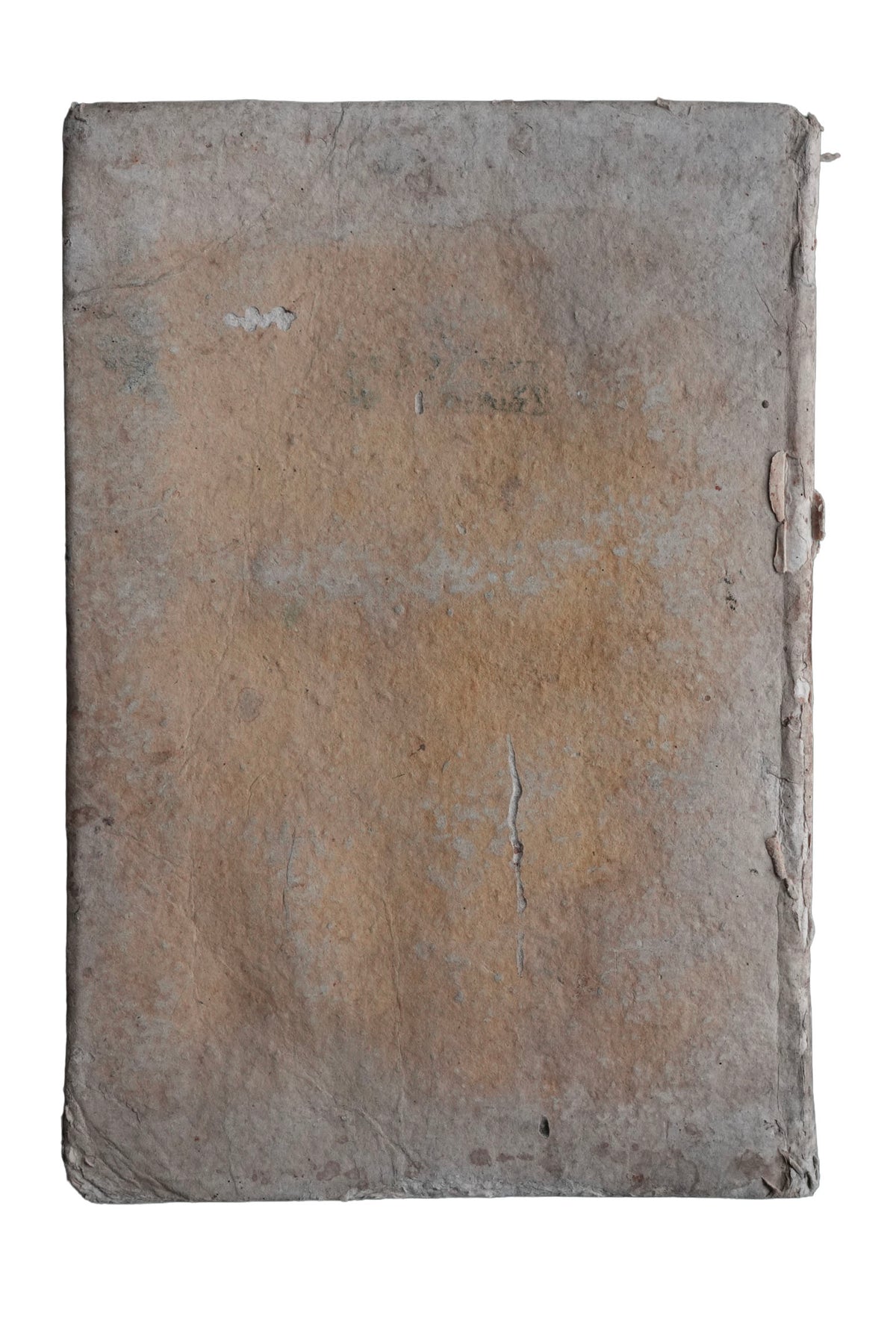
Old paper repair to f. 8r, with shadowing from adhesive tape passing through the text, though the text remains legible. Dampstaining to inner margins, more pronounced in the terminal leaves; some restoration affecting the text of the final leaf; marginal worm-tracks. Later binding, probably early eighteenth century, rubbed, chipped, and somewhat discoloured, but sound. Book-sticker to front blank; early inscription at head of title-leaf recto (*1r). Annotated throughout in a contemporary humanist hand, probably Italian. Wanting aa4 in the final gathering; otherwise, complete.
Polain (Suppl.) 4717; Goff S371; ISTC is00371000; GW M41245; BSB-Ink S-268; BMC V, 466
Share