An Early Manuscript Witness to the Contemporary Reception of Molière: Terence's Comedies, 1659
An Early Manuscript Witness to the Contemporary Reception of Molière: Terence's Comedies, 1659
Couldn't load pickup availability
An early manuscript witness to the contemporary reception of Molière
Terence, Publius (c. 195/185-159 BC).
Comoediae Sex.
Lutetiae Parisiorum: Petrum Lamy, 1659.
Octavo.
In a contemporary hand, the printed dramatis personae of Terence’s Eunuchus are accompanied by a near-complete manuscript cast, assigning a French name to almost every character. No recorded production of Eunuchus corresponding to this cast has yet been identified. The annotations therefore most probably preserve the cast of an otherwise unknown private, collegiate, provincial or travelling performance, or a contemporary theatrical adaptation in which Terence’s ancient characters were recast through the language of the seventeenth-century French stage.
The manuscript cast is especially remarkable because early manuscript evidence for the reception of Molière is extraordinarily rare. No autograph manuscript of any of his plays is known to survive, and very little manuscript material remains from the theatrical world in which they were first performed.
The names entered here form a striking Molièrean group. Léandre, Valère, Jacqueline and Perrin all appear together in Le Médecin malgré lui, first performed in 1666. La Flèche is the valet in L’Avare of 1668, while Silvestre is the servant in Les Fourberies de Scapin of 1671.
More importantly, the names are not assigned at random. In several cases the Terentian character is replaced by a Molière character of the same dramatic type. A young lover is recast as a Molière young lover; a servant is given the name of a Molière servant; and a female domestic character receives the name of a corresponding female domestic figure from Molière. The annotator therefore appears to have understood and deliberately matched the dramatic functions of the characters. The combination of repeated Molière names and repeated agreement in character type makes coincidence effectively improbable.
The annotations also include Mondor, a celebrated name from the older French comic theatre associated with Tabarin. The manuscript thus appears to place Terence directly within the living tradition of seventeenth-century French comedy, combining Molière’s characters with names inherited from the popular stage that preceded him.
The manuscript cast list may date from the 1670s and therefore preserve exceptionally early manuscript evidence for the immediate influence of Molière’s theatre, quite possibly from Molière’s own lifetime. That would make it one of the earliest surviving witnesses to the theatrical reception of Molière. The volume appears to record an otherwise unknown performance or theatrical adaptation of Terence in which the classical comedy was consciously recast through the characters and comic types of contemporary French theatre, including Molière.
1. Contemporary manuscript casting written next to character names from L’Eunuque (the Eunuch).
Condition
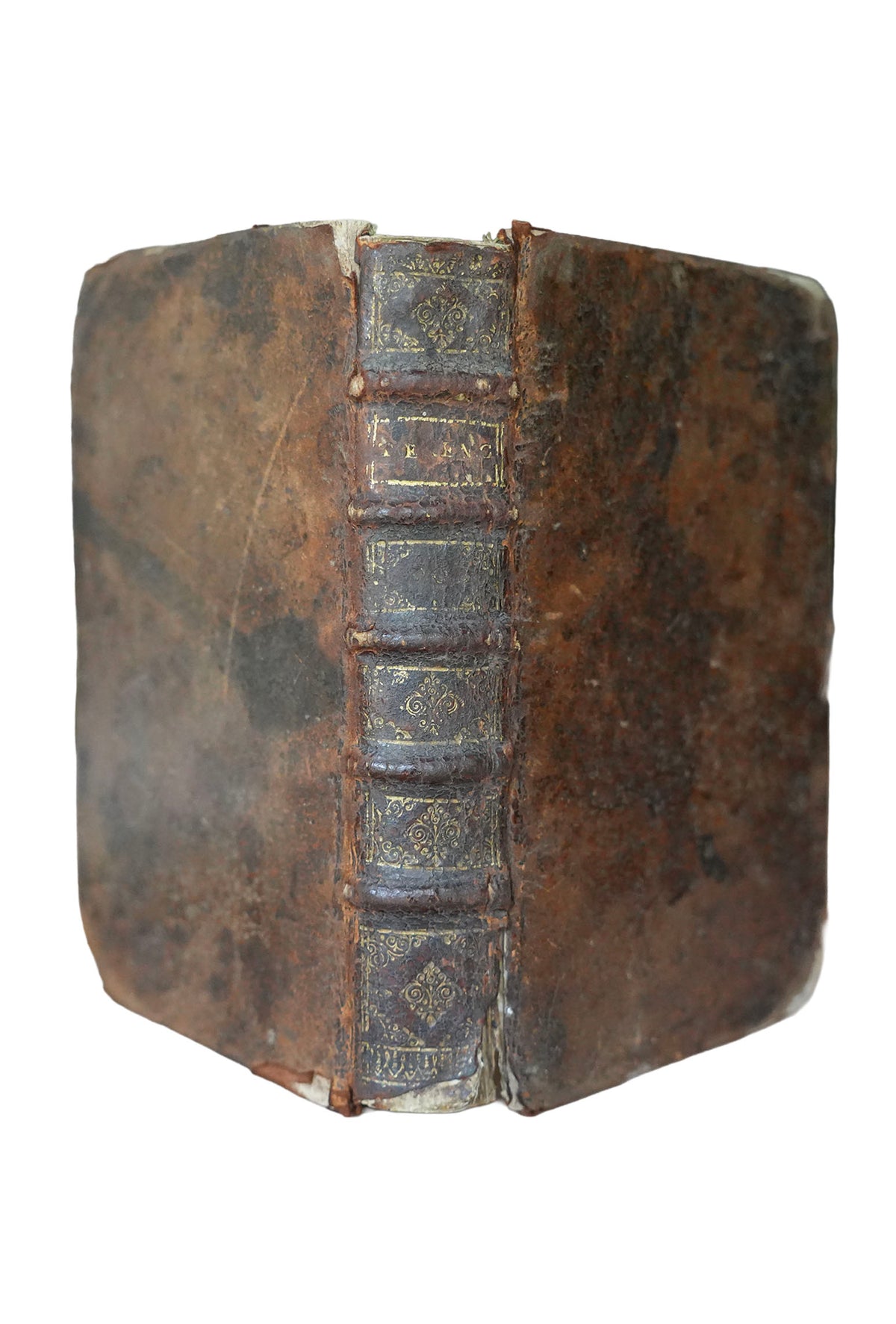
Contemporary calf binding with gilt to spine, worn and rubbed. Small loss to the bottom of the spine, and wear at extremities. Headcap and tailcap wanting. Red spotted page edges dulled. Ink “37” to front pastedown, and illegible ink inscription to the bottom of the frontispiece. Text block toned with sporadic minor dampstaining, most prominently to the first few pages. Rubbed out inscription to main title, illegible. Two crossed out abbreviations on E4 recto, mostly illegible. Small correction to E5 verso. Contemporary or near contemporary ink marginalia to I3 verso, appearing to be names of actors written next to character names.
USTC 6079002
Share