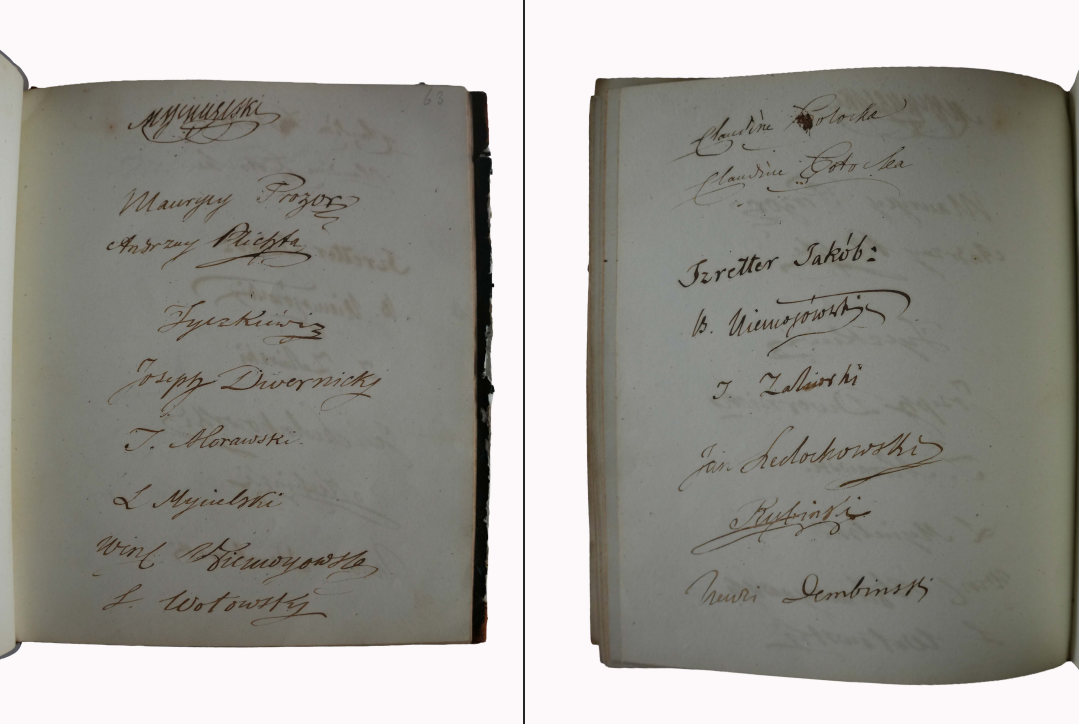
The Falkenstein Stammbuch: Polish Independence & Revolutionary Europe
Couldn't load pickup availability
A UNIQUE MANUSCRIPT ARCHIVE IN MINIATURE OF POLISH INDEPENDENCE AND REVOLUTIONARY EUROPE, c. 1815–1850
Perhaps the closest surviving thing to a manuscript map of nineteenth-century Europe drawn by its protagonists themselves, with Poland at its historical centre.
“For the historian, such collections, when formed according to a larger plan, with judgement and criticism, may open up many previously unused sources for the special history of the manners, culture, thought, and conduct of different peoples and historical epochs.”
— Constantin Karl Falkenstein, 1847.
The Falkenstein Stammbuch is one of the most extraordinary surviving manuscript monuments of nineteenth-century Europe: an apparently unique archive in miniature in which the political, literary and intellectual history of an age of revolution was assembled in the hands of the people who made it. Created over more than thirty years by Constantin Karl Falkenstein (1801–1855)—Chief Librarian of the Royal Library in Dresden, personal acquaintance and biographer of Tadeusz Kościuszko, Master of the Chair of the Dresden Freemason lodge Zum Goldenen Apfel, and one of Germany’s foremost manuscript collectors—it is the largest known coherent album-form survival of his celebrated system of arranging autographs into “world-historical groups or circles.” Its 289 entries by 288 individuals survive directly within the manuscript as signatures, inscriptions, quotations, declarations, dates and performances: not a collection of detached relics, but an attempt to preserve historical relationships in manuscript form.
Falkenstein’s intentions and access are well documented. In 1841 he was already described as making an “immense collection of autographs” and preferring not bare signatures but “some words with it”; the 1856 Handbuch für Autographensammler ranked him among Germany’s most zealous collectors and singled out his system of arranging autographs into “world-historical groups or circles.” His collecting grew directly from his work as librarian, historian, translator and intermediary.
Fryderyk Chopin recalled visiting the Dresden Royal Library in 1828 and finding Falkenstein copying a Kościuszko autograph “letter by letter,” enlisting Polish visitors to help translate its contents into German. Stefan Garczyński borrowed Polish historical books from him and later sent “a letter from General Umiński for your collection”; Princess Aniela Radziwiłł solicited autograph material from Silvio Pellico expressly for Falkenstein referring to him as “my friend”; and Karol Forster’s correspondence records Falkenstein securing recommendations and employment, making introductions and receiving clandestine politically informed communications from the Polish émigré world. Before his fame, Juliusz Słowacki frequented the Dresden Royal Library almost daily, where he knew, conversed with and “benefited from the kindness” of Falkenstein; Adam Mickiewicz consulted Falkenstein’s judgement on mystical literature during the formative Dresden period of Dziady III. Hans Christian Andersen travelled and lodged with Falkenstein and dictated poetry for him to translate; Falkenstein travelled to England c. 1837 in the suite of Princess Amalie Auguste of Saxony, the future Queen, where he received an invitation from the British Court; Falkenstein’s courtly reach extended from the Saxon royal household to Friedrich Wilhelm IV of Prussia, while his publications attracted subscriptions from Archduke Karl of Austria and other European dynasts; Richard Cobden recorded in his published diary Falkenstein’s assistance in Dresden and his eyewitness recollections of Tadeusz Kościuszko, contributing the free-trade inscription in the present manuscript on the same day; and Honoré de Balzac corresponded directly with him concerning a novel. His Stammbuch is therefore the surviving residue of a life conducted inside the literary, political and émigré networks it records.
At its centre lies an unparalleled manuscript pantheon of Polish independence: forty-eight figures on only three leaves, spanning the clandestine patriotic world of Walerian Łukasiński before his arrest in 1822, the Kalisz opposition and pre-revolutionary conspiracies, the commanders, ministers and parliamentarians who made the November Uprising, its martyrs who died before the struggle had ended, and the exiles who transformed military catastrophe into the Great Emigration. Chłopicki, Bem, Dembiński, Plater, Rybiński, Dwernicki, the Niemojowski brothers, Ludwik Pac and Klaudyna Potocka stand within the same manuscript sequence as the exceptionally rare autograph of Józef Longin Sowiński, one of the most celebrated martyrs of the November Uprising, alongside Piotr Bieliński (d. 1829), as well as Ignacy Mielżyński and Ludwik Mycielski, both of whom died during the Uprising itself. This political constellation could not have been manufactured retrospectively from the established heroes of a defeated revolution: part of it was already being assembled while that revolution was still history in the making, some as early as c. 1820.
The shockingly rare autograph of Walerian Łukasiński, entirely unknown on the market and necessarily preceding his arrest in 1822 and the forty-six years of imprisonment, mostly in solitary confinement, from which he never regained freedom, carries the sequence backwards into the clandestine origins of the independence movement. Remarkably, it is on the same page as the autograph of Józef Sowiński, bringing together on one page two of Poland's greatest national heroes and martyrs for independence.
Łukasiński’s presence also reveals how deeply Falkenstein had entered the clandestine patriotic world of Warsaw. This was not simply access to a prominent officer. Hanna Dylągowa’s reconstruction of National Freemasonry shows that, among some two hundred members, only Łukasiński and Kazimierz Machnicki fully understood its conspiratorial character; the Patriotic Society that followed was organised with still greater secrecy, its members divided into small cells and knowledge of the central leadership deliberately restricted. Łukasiński himself was at the centre of that system, recruiting members and directing its military organisation. That Falkenstein could obtain an autograph from him during these Warsaw years is therefore powerful documentary evidence that his Polish connections reached into the intimate inner circle of the clandestine independence movement from which the political culture of the November Uprising emerged.
The later Russian treatment of Łukasiński makes the survival still more extraordinary. At Schlüsselburg he was held as a secret prisoner under conditions intended to suppress even knowledge of his identity; his family’s later petitions were left unanswered by imperial order, they did not know whether he was still alive, he was buried in an unmarked grave, and official confirmation of his death was not issued to his relatives until 1876. The Russian state attempted to consign Łukasiński to obscurity; Falkenstein’s Stammbuch preserves him in his own hand from the years when he was still directing the clandestine struggle for Polish independence. As far as the course of research has been able to establish so far, the present example is the only known autograph of him which is unrelated to his trial and imprisonment and thus the last surviving physical trace of his freedom, here made all the more significant by the dozens of other Polish national heroes who sign their names by his.
At the other end stand the soldiers, politicians, writers and organisers of the Great Emigration. The Stammbuch therefore preserves the same political society on both sides of the catastrophe of 1830–31: first within Poland, then dispersed across Europe and reconstructing national life abroad. Every one of the forty-eight figures appears in Józef Straszewicz’s monumental contemporary Les Polonais et les Polonaises de la Révolution du 29 Novembre 1830, with forty-seven receiving individual biographies, demonstrating the coherence of the group. Similarities between several manuscript signatures and Straszewicz’s printed facsimiles, coupled with Falkenstein’s links to Paris publishing and engravers, even raise the possibility, still to be demonstrated, that the present manuscript supplied exemplars for that foundational attempt to memorialise the generation of the November Uprising. For the vast majority of the forty-eight entries, their autographs have never appeared for sale in the traceable auction and retail records and are therefore otherwise individually unobtainable.
Falkenstein’s “world-historical” method was not merely an intellectual system imposed retrospectively upon material already collected: his Stammbuch itself appears to have functioned as an instrument through which his network expanded. Like the great early modern Stammbücher of courtly, diplomatic and learned society, it offered visible proof of access to distinguished circles and could itself facilitate further introductions. This makes the juxtapositions within it especially significant. The Polish leaves do not present a retrospective pantheon purified of disagreement, but preserve within the same manuscript space men divided by strategy, temperament and political allegiance: Chłopicki beside Tomasz Łubieński, whom he later blamed for the disputed failure to attack at Grochów; Bonawentura Niemojowski beside Maciej Rybiński, embodying the competing civilian and military authorities of the Uprising’s final constitutional crisis. After defeat, many of the same generation transformed themselves from soldiers and politicians into founders of learned societies, libraries, archives and émigré institutions, including the Historical and Literary Society in Paris and the networks that ultimately sustained the Polish Library there. The Falkenstein Stammbuch therefore records not only the struggle to recover a Polish state, but the remarkable transformation by which its defeated political generation became an archival and institutional one: when sovereignty had been lost, the preservation of national memory itself became a form of political survival.
Falkenstein himself is inseparable from this Polish history. He had known Kościuszko personally in Switzerland; in 1820 he entered the Warsaw household of Count Franciszek Łubieński; his 1827 life of Kościuszko became the first complete German biography of the Polish hero and later entered the publishing culture of the Great Emigration through Karol Forster’s French translation. After 1831, Polish émigrés used Falkenstein and the Royal Library for books, research, introductions and assistance. Friedhilde Krause later described him not only as a chronicler of Polish history but as “one of the creators of the historical image of the Polish hero.” His Stammbuch does not impose Polish significance upon an unrelated German collection: it is the manuscript expression of a lifelong engagement with Poland extending from Kościuszko’s living memory through the intellectual worlds of Mickiewicz and Słowacki into the November Uprising, Great Emigration, revolutions of 1848–9 and the generation of the 1863 January Uprising.
Yet the manuscript repeatedly expands from Poland into the history of Europe itself and repeatedly catches history in the act of becoming history. King Friedrich Wilhelm IV of Prussia writes his own declaration of his belief in the divine right of kings on 26 June 1847, the very day he dissolved the First United Diet, alongside the future Emperor Wilhelm I, preserving a direct witness in the King’s own hand to the event that culminated in the 1848 Berlin Revolution; the Czartoryskis (including the then teenage Prince Władysław, later founder of the Czartoryski Museum and leader of the Hôtel Lambert) appear during the revolutionary crisis on 10 May 1848, the very day after the end of the Greater Poland Uprising and on the same day as the restoration of their Sieniawa estate alongside prominent Polish aristocrats (Czapski, Plater, Chodkiewicz, Rupniewski, Twardowski, etc.); Honoré de Balzac leaves La misère est la mère du génie, quoting Napoleon, probably during his 1845 Dresden journey with his future Polish wife Ewelina Hańska and Count Mniszech, while independent records preserve his direct communication with Falkenstein about a novel; Zacharias Dase turns an entire page into the record of an astonishing feat of mental calculation; and the great Orientalists and scholars of 1844 gather at the formative moment from which the Deutsche Morgenländische Gesellschaft emerged, many of whom were based in Breslau, modern day Wrocław.
Its literary and human range reaches an almost unbelievable climax on a single leaf. Percy Bysshe Shelley and William Wordsworth, the two towering poetic antagonists of British Romanticism, who never met in life, are united here in manuscript, apparently for the first and only time on a single surviving leaf yet traced. That conjunction alone would make the page extraordinary. But Falkenstein did something far more remarkable: around them he assembled Francis Jeffrey, John Wilson, Thomas Chalmers, John Gibson Lockhart and Samuel Halkett, all influential figures from the critical and intellectual world that judged, attacked, defended and ultimately canonised the literature of the Romantic age. The result is not simply a page containing two great poets, but something approaching a manuscript microcosm of British Romanticism itself: its creators, adversaries, interpreters and arbiters compressed into one physical space in a constellation that history itself never produced. No comparable single leaf has yet been identified.
At its centre stands the autograph of Shelley, whose manuscript material is of legendary rarity. Its probable date makes its survival more extraordinary still: Falkenstein most plausibly acquired it during the Geneva summer of 1816, when the twenty-three-year-old Shelley belonged to the circle of Mary Godwin and Byron from which Frankenstein emerged and one of the defining episodes of European Romanticism unfolded. Even the physical chronology of the page is tantalising: had Wordsworth already occupied it, the conjunction that Falkenstein ultimately created may never have been possible as Shelley almost certainly would have refused to sign alongside Wordsworth. Yet he did not preserve the leaf merely as a relic of 1816. Samuel Halkett’s entry cannot pre-date 1848, proving that Falkenstein continued to construct this extraordinary constellation for more than thirty-two years. The page therefore compresses an entire historical transformation into a single sheet: it begins, most plausibly, with an autograph obtained while Shelley was alive, twenty-three years old and Romanticism itself still incandescent, and ends with additions made after Shelley had been dead for more than a quarter of a century and the world he inhabited had already become literary history. Few manuscript objects could embody the Romantic age with greater concentration. What survives here is a British Romantic pantheon in miniature, except that, unlike any retrospective monument, it was assembled from the actual hands of the people who made, opposed, interpreted and inherited that age.
Falkenstein's Stammbuch repeatedly preserves not merely celebrated individuals, but the different mechanisms through which nineteenth-century nations imagined, recovered and institutionalised themselves. Hans Christian Andersen appears within an extraordinary Danish constellation that places literature beside the scholarly construction of national memory. On the same leaf stand Christian Jürgensen Thomsen, architect of the Three-Age System; his archaeological successors Jens Jacob Worsaae, Christian Frederik Herbst and Conrad Engelhardt; Jørgen Andresen Bølling of the Royal Danish Library; and the theologian and National Liberal Henrik Nicolai Clausen. The page is almost a diagram of how a modern nation created a past for itself: through archaeology and the museum, the library and scholarship, literature and ultimately constitutional politics. Elsewhere Denmark’s national poet Adam Oehlenschläger and the Swedish Romantic Erik Gustaf Geijer extend the manuscript across the literary construction of northern European national cultures. Most strikingly, Vuk Karadžić appears beside the exiled Prince Mihailo Obrenović, compressing onto one page two complementary projects in the creation of modern Serbia: Karadžić’s reconstruction of national culture through language, folklore and oral tradition, and Mihailo’s embodiment of dynasty, statehood and political sovereignty. In Poland the same pattern assumes still greater historical weight: Józef Gwalbert Pawlikowski, director of the Ossolineum, appears beside his young son Mieczysław, later a participant in the January Uprising—the preservation of national memory through the library physically joined to the generation that would again attempt to recover the nation by force.
The manuscript's range extends far beyond these national constellations. Members of the British royal family appear around Princess Mary Adelaide of Cambridge on her tenth birthday alongside European dynastic figures including Frederick William, Hereditary Grand Duke of Mecklenburg-Strelitz; Amschel Mayer von Rothschild and James Fargo represent international finance, while Richard Cobden, William Smith O’Brien, Francis Lieber, Adam Wilhelm Moltke and Eduard von Simson carry the Stammbuch through liberalism, nationalism, constitutional government and revolution—Simson signing only a day before the dissolution of the Frankfurt revolutionary parliament. James Martineau, Henri-Frédéric Amiel and Giuseppe Ferrari extend it into theology, philosophy and political thought; Otto Nicolai, Ferdinand Hiller, Aloys Schmitt and Václav Jan Křtitel Tomášek into European musical culture; Alexandru II Ghica into the dynastic politics of south-eastern Europe; and a remarkable group of politically divided Hungarians preserves, immediately before 1848, an aristocratic political society whose differences were about to be forced into open revolution.
No less remarkable is the world concerned with creating and preserving culture itself. Paul Delaroche and Julie von Egloffstein represent European painting, the latter emerging from the intimate Weimar circle of Goethe, while Charles Coffin Jewett, Karl Morgenstern and Ferdinand Wolf belong to the international history of libraries, cataloguing and scholarly institutions. Morgenstern, first director of the library of the Imperial University of Dorpat and the scholar who coined the term Bildungsroman, stands particularly naturally in a stammbuch created by another librarian intent upon organising literary history. Moritz Steinschneider, later one of the foundational figures of modern Jewish bibliography, represents the systematic recovery and classification of an entire textual civilisation; and the Polish count Kajetan Dunin-Borkowski, author of the pioneering O obowiązkach bibliotekarza and a scholar of the medieval Florian Psalter, brings the same concern with libraries, bibliography and historical memory back into the Polish intellectual world. The Stammbuch also preserves revealing acts of self-identification: Count Aleksander Krasicki of Siecin, for example, styled himself explicitly as the “petit-neveu d’Ignace Krasicki,” defining his place in Falkenstein’s collection through descent from one of the canonical figures of Polish Enlightenment literature. The Stammbuch consequently contains not only the writers, rulers and revolutionaries who made nineteenth-century history, but the librarians, bibliographers, archaeologists and museum-builders who decided how that history and the cultures behind it would be recovered, classified and remembered.
At its furthest human reaches stand the celebrated Italian magician Bartolomeo Bosco and Aquasi Boachi, prince of the Ashanti kingdom and later the first Black mining engineer in the Dutch East Indies. Kings and revolutionaries, exiled princes and makers of national languages, financiers and philosophers, national poets and prime ministers, painters and composers, librarians and archaeologists, mathematicians and magicians, European scholars and an African prince inhabit the same surviving manuscript world. What might at first appear as extraordinary diversity is in fact one of the Stammbuch's deepest historical meanings: Falkenstein preserved, in the hands of its participants, not only the people who remade the nineteenth-century world, but those who excavated its past, organised its knowledge and determined how it would be remembered.
That extraordinary breadth is precisely what Falkenstein’s own 1847 statement explains. He did not regard such collecting as an accumulation of celebrity but as a means of opening new sources for the history of peoples and epochs. The manuscript preserves political factions, families, travelling parties, court visits, scholarly gatherings and chronological accretions; ink transfer between facing pages proves the present sequence existed by at least the early 1830s, but probably originally. To disperse it would preserve many valuable autographs while destroying the rarer object: the historical relationships Falkenstein deliberately preserved between them.
For all its continental breadth, however, the deepest meaning of the Falkenstein Stammbuch is Polish. It preserves within one coherent manuscript the passage of a nation from conspiracy and constitutional opposition through insurrection, sacrifice and defeat into exile, institutional survival and renewed European revolution. Its survival has particular resonance in a country whose documentary inheritance was repeatedly subjected to confiscation, removal and dispersal under the partitions and after failed uprisings, before the catastrophic destruction of Polish libraries, archives and manuscript collections in the twentieth century. Against that history of displacement and destruction, the survival of forty-eight figures of the Polish independence movement together in a single coherent manuscript is more than ordinary rarity: it is an extraordinary accident of national memory, preserving together a political generation whose documentary inheritance history repeatedly conspired to scatter.
The Falkenstein Stammbuch is perhaps the closest surviving thing to a manuscript map of nineteenth-century Europe drawn by its protagonists themselves, with Poland at its historical centre. It preserves almost the entire generation of the leadership of the November Uprising within the same manuscript as other revolutionaries, leaders, and representatives of romanticism across Europe. It is a uniquely coherent manuscript record of the Polish independence generation from the clandestine patriotic movement before 1830, through the November Uprising, into the Great Emigration and the preservation of Polish national memory in exile.
No parallel has yet been identified combining its concentration of Polish independence history, international range, substantive manuscript content, chronological immediacy and surviving intellectual structure. It is an irreplaceable monument to the survival of a nation without a state, and to the men and women who carried the idea of Polish independence from Kościuszko and Łukasiński through November 1830 and the Great Emigration, into the revolutionary world of 1848 and the political inheritance later borne by the 1863 January Uprising.
More comprehensive details are available upon request, including a complete list and transcription of entries, additional photographs, chronological and prosopographical analysis and further commentary.
1. Constantin Karl Falkenstein, compiled between c. 1815 and c. 1850.
2. Falkenstein’s autograph collection was dispersed on the market after his death: Günther/Schulz record the Catalogue de la riche collection de lettres autographes de feu Mr. Const. Ch. Falkenstein in two parts, sold publicly at T. O. Weigel, Leipzig, on 7 April and 2 June 1856
3. Acquired from the liquidation of the Vienna-based Galerie und Auktionshaus Hassfurther, thereafter researched, each entry identified, and its significance subsequently understood.
4. Exported from Austria to Poland with permission from the Austrian Ministry of Culture, documentation available upon request.
5. Checked against lost, stolen and illegal export registers including Skradzione Zabytki, Katalog strat wojennych, INTERPOL, the ILAB Missing Books Register, the German Lost Art Foundation database, and the Austrian National Fund Art Database with no matching records found for the present object. On all available evidence, the present manuscript has remained in private hands since Falkenstein's ownership of it.
Condition
Ninety-one contemporary numbered leaves, of which fifty-five contain 289 autograph entries by 288 individuals; the remainder blank. Probably contemporary manuscript foliation throughout in pencil. Entries in German, French, English, Polish, Latin, Italian, Danish, Swedish, Russian, Hungarian, Serbian in Cyrillic, and other languages. All autographs are entered directly into the album; there are no mounted cuttings or subsequently inserted autograph fragments. The present arrangement was demonstrably established by at least the early 1830s through ink transfer between facing leaves, corresponding patterns of wear and the surviving binding structure and was most probably formed in this order originally. The paper stock of each leaf appears to be the same and observation of codicology further suggests completeness and that the leaves were originally bound in their present order in the present binding. No leaves are obviously wanting and the numbering continues without gaps. Several leaves detached or loose but retaining their original position. Minor wear and occasional foxing. Contemporary binding, probably original; spine reinforced with tape at an early date, front board detached. The historical structure of the Stammbuch remains intact.
Andersen, Hans Christian. 1844. “H. C. Andersen, diary entry for 10 July 1844.” In “Læs i brevvekslingen mellem H.C. Andersen og familien Serre.” The Hans Christian Andersen Centre, University of Southern Denmark. 10 July 1844.
Antiquariat InLibris Gilhofer Nfg. GmbH. 1847. “Richard Cobden, autograph letter signed to Constantin Karl Falkenstein, British Hotel, Dresden, 23 July 1847, 1 p. on bifolium, 8vo, on ‘Bristol’ stationery.” Antiquariat InLibris. 23 July 1847.
Antiquariat V. A. Heck. 1937. Catalogue 65: Autographs, no. 16. Vienna.
Bagłajewski, Arkadiusz. n.d. Dresden: Atlas of Polish Romanticism. Maria Curie-Skłodowska University.
Beinek, Justyna. 2004. “Forget-Me-Not: National Identity in Nineteenth-Century Polish Albums.” The Sarmatian Review.
Bibliothèque nationale de France. 2015. BnF essentiels.
Burdziej, Bogdan. 1995. “Moje więzienia (1832) Silvio Pellico w Polsce.” In Zapomniane wielkoromantyzmu, 249–265.
Carolsfeld, Franz Schnorr von. 1877. “Falkenstein, Constantin Karl.” Allgemeine Deutsche Biographie 6: 556. Historical Commission at the Bavarian Academy of Sciences.
Chopin, Fryderyk. 1828. “Letter of 20 September 1828 describing a visit to the Royal Library in Dresden and an encounter with Falkenstein.” In Chopin’s Letters and archival editions. Dresden, 20 September 1828.
Claerhout, Veerle, and Idesbald Goddeeris. 2002. “Between Conservatism and Radicalism: Wincenty Tyszkiewicz in Belgium (1833–1848).” Roczniki Humanistyczne, 1–38.
Dylągowa, Hanna. 1973. “Łukasiński Walerian.” Polski Słownik Biograficzny 18: 532–534. Wrocław–Warszawa–Kraków–Gdańsk. Digitised in Internetowy Polski Słownik Biograficzny.
Dylągowa, Hanna. 1996. “Walerian Łukasiński – Wolnomularstwo Narodowe i Towarzystwo Patriotyczne (1819–1826).” Miscellanea Historico-Archivistica 6: 133–151. Warsaw: DiG.
Ense, Karl August Varnhagen von. 1859. Organ für Autographensammler und Autographenhändler. Edited by Dr. Johannes Gunther. Vol. 1. München: Jena Deistung.
Evans, David Owen. 1929. “An Unpublished Letter of Balzac.” Modern Language Notes, January 1929: 15–17.
Falkenstein, Ch. 1839. Thadée Kosciuszko, dans sa vie politique et intime. Paris: Firmin Didot.
Falkenstein, Konstantin Karl. 1827. Thaddäus Kosciuszko. Leipzig: F. A. Brockhaus.
Gadon, Ludwik. 1889. Przejście Polaków przez Niemcy po upadku powstania listopadowego. Poznań: Drukarnia Dziennika Poznańskiego.
Gunther, Joh., and Otto Aug. Schulz. 1856. “X. Erwerbungsart der Autographen.” Chap. 10, p. 183. Leipzig.
Günther, Otto. 1856. Handbuch für Autographensammler. Leipzig: T. O. Weigel.
Hoffmanowa, Klementyna. 1858. Drezno i jego okolice. Warszawa.
Hoffmanowa, Klementyna. 1876. Dzieła Klementyny z Tańskich Hofmanowej. Wydanie nowe pod redakcyą Narcyzy Żmichowskiej z dodaniem życiorysu i objaśnień. Vol. 5. Warsaw: Edward Wende.
Hösick, Ferdynand. 1897. Juliusz Słowacki (1809–1849): biografia psychologiczna, 285–286.
Jäckel, Günter. 1997. “Adam Mickiewicz und die Dresdner Totenfeier. Wechselbeziehungen zwischen polnischer und deutscher Literatur.” In Polen und Sachsen: Zwischen Nähe und Distanz.
Jaskuła, Roman. 2002. “Karol Forsters Briefe an Karl Konstantin Falkenstein: Eine Quelle für die deutsch-polnischen Beziehungen im 19. Jahrhundert.” Makkaroni und Geistesspeise. Almanach der Varnhagen Gesellschaft 2: 233–262. Berlin.
Karasowski, Maurycy. 1882. Fryderyk Chopin. Życie – Listy – Dzieła. Warsaw: Nakład Gebethnera i Wolffa.
Ketterer Kunst. 2004. “Lot 1103: Stammbuch des Theologen L. Creutzer, Jena 1791.”
Ketterer Kunst. 2026. “Hans Christian Andersen: Eigh. Gedicht m. U., 1844.” Lot 265, Sale 604: Rare Books. Hamburg: Ketterer Kunst, 18 May 2026.
Kraszewski, Józef Ignacy. 1977. Postcards from a Journey 1858–1964. Edited by P. Hertz. Vol. 2. Warsaw.
Krause, Friedhilde. 1994. “Saksoński bibliotekarz Konstantin Karl Falkenstein (1801–1855) a Polacy.” Rocznik Biblioteki Narodowej, 59–69.
Lam, Andrzej. 2015. Anioł Ślązak Mickiewicza. Universitas TAiWPN.
Limanowski, Bolesław. 1935. Walerjan Łukasiński: szkic biograficzny. Warszawa: J. Mortkowicza.
Mączkowski, Andrzej. 2014. “150. rocznica śmierci zapomnianego Feliksa Nowosielskiego.” gpr24.pl.
McLean, Justin. 2022. “The Rift Between Wordsworth and Shelley.” HubPages.
Mencfel, Michał. 2022. “Aesthetic Views, Writings on Art, Patronage.” In Athanasius Raczyński (1788–1874). Aristocrat, Diplomat, and Patron of the Arts, 349–409.
Mickiewicz, Adam. 1839. “Letter to Bronisław Trentowski, 9 September 1839.” In Dzieła. Wydanie Rocznicowe, vol. 15, p. 488. Czytelnik.
Mickiewicz, Adam. 1998. Listy. Część pierwsza: 1815–1829. In Dzieła. Wydanie Rocznicowe, vol. 14. Edited by M. Dernałowicz, E. Jaworska and M. Zielińska. Warsaw.
Mickiewicz, Adam, and Bronisław Ferdynand Trentowski. 2003. “Letter of 9 September 1839.” In Adam Mickiewicz, Dzieła. Wydanie Rocznicowe. Listy. Część II: 1830–1841, vol. 15, p. 488. Czytelnik.
Morley, John. 1881. The Life of Richard Cobden. Vol. 1. London.
Niecks, Frederick. 1902. Frederick Chopin as a Man and Musician. 3rd ed. Vol. 1. London and New York.
Nitzschke, Katrin. 2012. “Constantin Carl Falkenstein.” Sächsische Biografie. Institut für Sächsische Geschichte und Volkskunde.
Odyniec, Antoni Edward. 1961. Letters from a Journey. Edited by M. Toporowski. Vol. 1. Warsaw.
Ossolineum. 2011. “Historia ZNiO.” 3 February 2011.
Patty, James S. 1985. “Balzac et Dürer.” In Mélanges de littérature en hommage à Albert Kies, edited by Claude Pichois, 201–211. Presses universitaires Saint-Louis Bruxelles.
Płomińska-Krawiec, Ewa. 2011. “‘Freiheit ohne Gehorsam ist eine Verwirrung (...)’ – zu den nationalen Selbst- und Fremdbildern.” In Deutsch-Polnischen Verhältnis zwischen Restauration und Gründerzeit, 32.
Słowacki, Juliusz. 1983. Listy do matki. Edited by Z. Krzyżanowska. Vol. 6. Wrocław.
SLUB. n.d. “Konstantin Karl Falkenstein.” Bibliothekare im Porträt.
Stern, Ludwig. 1911. Die Varnhagen von Ensesche Sammlung in der Königlichen Bibliothek zu Berlin. Berlin: Behrend & Co.
Sudolski, Zbigniew. 1967. “Stefan Garczyński w świetle nowych źródeł.” In Miscellanea z lat 1800–1850, 338.
Tazbir, Janusz. 1978. Piotr Skarga, Szermierz kontrreformacji. Warszawa: Państwowe Wydawnictwo “Wiedza Powszechna”.
Tomczyk, Paweł. 2026. “240 lat temu urodził się Walerian Łukasiński – polski żołnierz więziony przez 46 lat.” Dzieje.pl.
Weaver, Michael. 2022. “Political Friendship: Liberal Notables, Networks, and the Pursuit of the German Nation-State, 1848–1866.” Department of History, University of Toronto.
Weibel, Andrea. 2018. “Konstantin Karl Falkenstein.” Historical Dictionary of Switzerland (HLS). 15 March 2018. Accessed 2026.
Wesołowski, Janusz. 2017. “Listy Józefa Sowińskiego do Katarzyny Schroeder Jonasowej z lat 1812–1813. Cz. I.” Niepodległość i Pamięć, 381–402. Muzeum Historii Polski.
Whewell, Cordelia. [19th cent.]. “MS c/65/53: Letter from Constantin Karl von Falkenstein to an unidentified person.” Trinity College Cambridge Archives.
Wyka, Kazimierz. 1975. “Adam Mickiewicz.” Polski Słownik Biograficzny 20.
Young, Tom. 2024. “Picturing Novembrists in Paris: Gender and Diasporic Politics in Józef Straszewicz’s ‘Historical Gallery of Contemporary Poland’.” The Polish Review.
Zgorzelski, Czesław. 1967. Miscellanea z lat 1800–1850. Wrocław–Warszawa–Kraków: Zakład Narodowy im. Ossolińskich / Wydawnictwo Polskiej Akademii Nauk.
Ziejka, Franciszek. 2017. “Tadeusz Kościuszko dans la mémoire des nations.” In Kościuszko – héros de deux continents.
Share