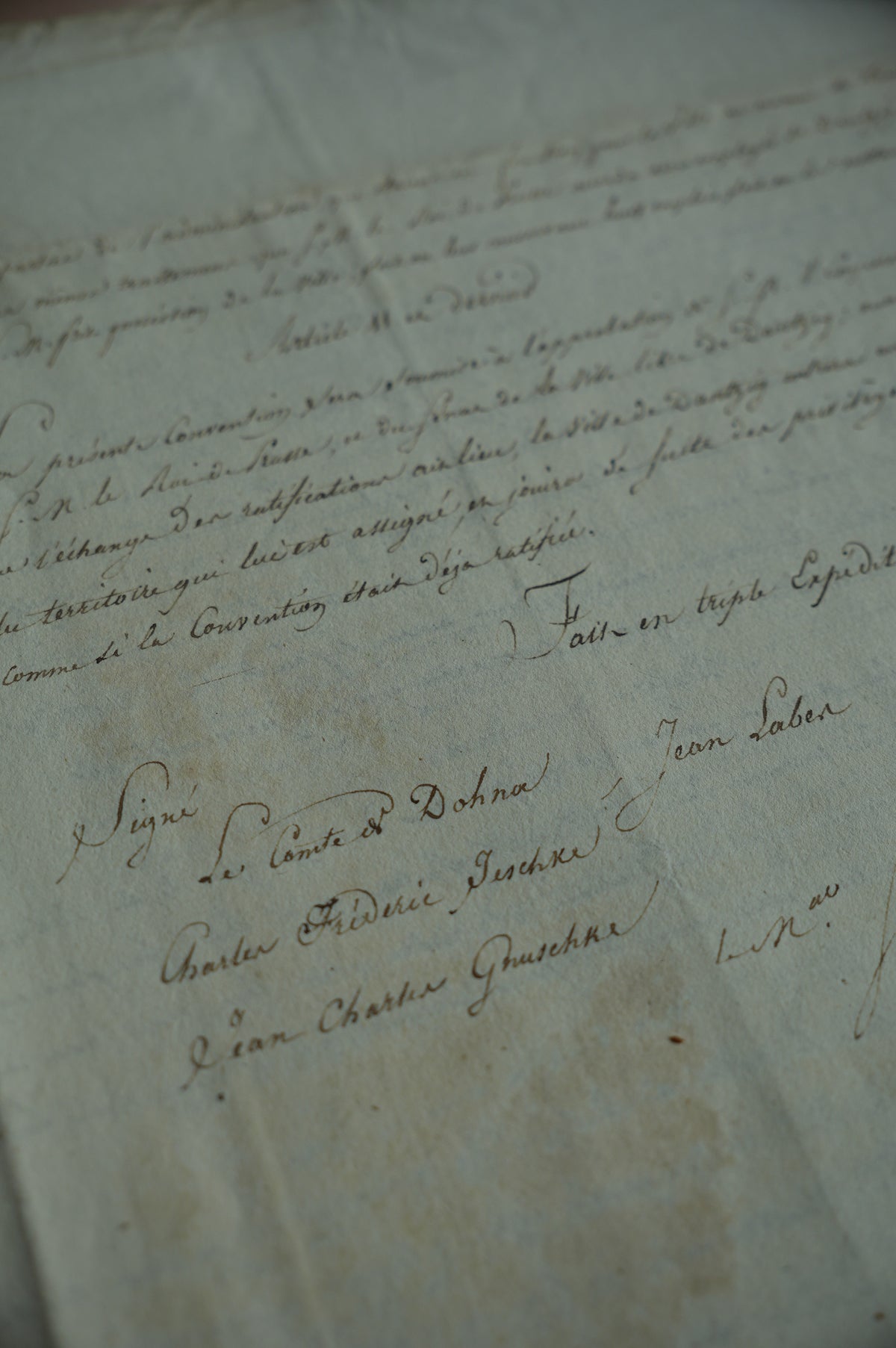
The Foundational Documents of Gdańsk, 1807
Couldn't load pickup availability
Nineteen pages concerning the final territorial settlement of the Free City of Gdańsk: two signed memoranda by Friedrich zu Dohna Schlobitten (1771–1831), with contemporary manuscript copies of his royal full powers issued by King Frederick William III and of the Convention of Elbing.
Memel and Elbing, 25 October–6 December 1807.
Folio. 19 pages.
The original papers from the final negotiations that gave the Free City of Gdańsk its territory.
An exceptional survival from the creation of Napoleonic Gdańsk: the coherent working sequence preserved in Marshal Soult’s archive, comprising Prussia’s last resistance, its compelled acceptance, and the French archival copy of the Convention that fixed the new state’s frontiers.
The Treaty of Tilsit restored Gdańsk’s independence in July 1807 but left its physical extent unresolved. The dispute turned on the interpretation of the “two leagues” promised to the city and, more concretely, on control of the fertile Żuławy (Danziger Werder), the Nehrung, the lower Vistula and its delta. Behind the territorial question lay the larger issue of French evacuation of Prussian territory.
On 1 December 1807 Dohna submitted a lengthy signed memorandum challenging the proposed frontier. He calculated its consequences in land, population and revenue, and demanded written confirmation that the line advanced on 7 November represented Napoleon’s express decision, communicated from Fontainebleau on 16 November. No corresponding imperial instruction has been identified in Napoleon’s published correspondence. The memorandum also linked territorial concessions to the withdrawal of French administration east of the Vistula and of at least 30,000 troops beyond the Oder and ultimately the Elbe.
Five days later Prussia yielded. In his second signed memorandum, dated 6 December, Dohna recorded Soult’s declaration that Napoleon’s orders of 16 November constituted an irrevocable decision (“volonté irrévocable”) and that continued resistance risked postponing evacuation until the following spring. Under this pressure, and in view of Prussia’s desperate condition, Frederick William III authorised signature. Dohna calculated the cost with precision: more than four and a half square miles and 9,289 inhabitants beyond what Prussia believed Tilsit required; for Gdańsk, a gain of over one-fifth in territory, 13,853 inhabitants, and roughly double its previous territorial revenue.
The sequence culminates in Soult’s contemporary manuscript copy of the Convention of Elbing, concluded the same day. Its eleven articles traced the frontier from the Baltic through the country around Gdańsk to the Vistula and across the delta; declared the enclosed territory the full property and sovereignty of the Free City; assigned the Hel Peninsula (with defined exceptions); regulated navigation, fisheries, lighthouses, shipwrecks and river islands; and ordered the erection of boundary posts bearing the arms of Napoleon, the King of Prussia and the King of Saxony, with the inscription “Territoire de la Ville libre de Dantzig”. The final article directed Gdańsk to take immediate possession “comme si la Convention était déjà ratifiée.”
The Convention was printed at Elbing in 1807 and later included by Andrzej Bukowski in Pomorze Gdańskie 1807–1850 (1958) and by Marian Kallas and Marek Krzymkowski among the principal documentary texts of the Napoleonic reorganisation of the Polish lands. The signed memoranda, by contrast, appear never to have been published in full. They preserve the argument, the pressure, and the calculations that the printed text necessarily omits.
The three documents were registered consecutively in Soult’s headquarters archive as pieces 917, 918 and 919. They formed part of a larger dossier concerning the occupation, evacuation and territorial settlement of Prussia after Tilsit. The Convention itself was executed in three counterparts; the precise survival of the signed originals remains to be established, but none have so far been located. The present manuscript is the contemporary copy retained by the French plenipotentiary who mediated the settlement, preserved together with the two original Prussian memoranda that explain how agreement was reached.
Napoleon ratified the settlement in Paris on 5 February 1808. The ratified instrument is now in the Archiwum Państwowe w Gdańsku. These nineteen pages preserve something the ratification and the printed Convention cannot: the negotiation itself. A complete transcription of all nineteen pages is available upon request.
- Marshal Nicolas Jean-de-Dieu Soult (1769–1851), received correspondence, preserved in his archive; by
family descent. - Dispersed from the larger Soult dossier, Gros & Delettrez, Paris, 14 December 2007, lot 97.
- French manuscript trade; recently exported to Poland.
Condition
Folio sheets, the two contemporary copies in slightly larger sheet sizes. Bulletin Analytiques sheets all affixed to their respective documents by means of a nail. The contemporary copy of the Friedrich Wilhelm III powers does not have the Bulletin Analytiques sheet. Generally all sheets are in bright and fresh condition without any visible ink degradation with the text remaining fully legible on all pages. The “n” initial on the outer margin of the recto of the two documents headed “Note” is the initial of Marshal Soult, consistent with other known received communication by him.
Share