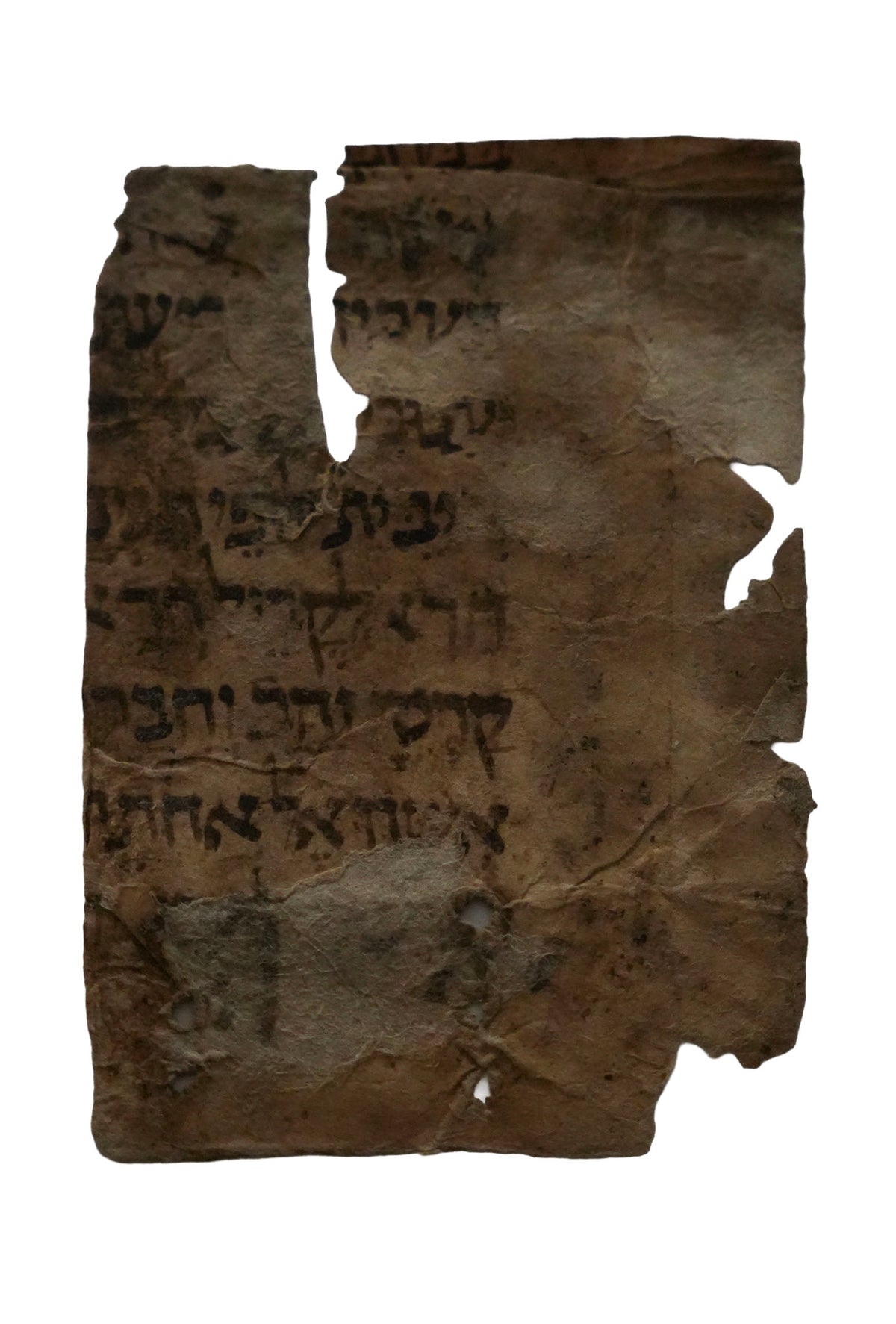
The Oldest Hebrew Bible Manuscript in Poland, c. 975-1100
The Oldest Hebrew Bible Manuscript in Poland, c. 975-1100
Couldn't load pickup availability
Parshat Terumah - Exodus 26:2-6 with Targum Onqelos.
Manuscript on paper. Likely Babylonia or North Africa.
Circa 975–1100.
Among the earliest surviving Hebrew Bible manuscripts, with the Targum, in codex form.
Single leaf fragment. Written in an elegant, bold Oriental square script in a single-column format. Fully vocalised and accented (niqqud and ta'amim), without Masorah.
This fragment is an exceptionally early witness to the transmission of the Torah. Several conservative palaeographical markers support a proposed dating of the leaf to around the turn of the first millennium (c. 975–1100 CE).
First, the scribe uses letter elongation (dilatation) to achieve left-margin justification, strictly avoiding partial or ‘filler’ letters. This habit strongly favours an origin in North Africa or Babylonia over Egyptian or Palestinian traditions.
Second, the scribal orthography, the archaic structure of the sof pasuq markers and the morphology of particular characters point to a transitional period in Oriental scripts. The lack of a formal Masorah (marginal notes), combined with the highly competent but personal execution, suggests this may have been an owner-produced codex, written by a scholar for private study rather than a community synagogue scroll, perhaps for Terumah in the nineteenth Shabbat after Simchat Torah.
The manuscript captures a vital section of Parshat Terumah, detailing the exact dimensions and construction of the Tabernacle's curtains. Crucially, the text alternates seamlessly between the original Hebrew and the classical Aramaic translation, Targum Onqelos.
The earliest surviving witnesses to Targum Onqelos occur on two fifth- to seventh-century CE incantation bowls discovered at Nippur, Babylonia. This leaf, however, belongs among the very earliest surviving manuscript witnesses, which date from the tenth and eleventh centuries.
While the Hebrew alignment with the standard Masoretic text is precise, the Aramaic portions do yield a compelling textual variant when compared against the standard Comprehensive Aramaic Lexicon (CAL) text:
Exodus 26:2 (recto): variant vocalisation/spelling of אָכְרָא (orka) for “the length of,” contrasting with the more common אָורכּא (urka).
Exodus 26:4–6 (verso): displays distinct orthographic variations in prefixing, notably utilising די in place of the standard ד.
Unlike the vast majority of surviving medieval Hebrew paper fragments, this leaf most likely does not originate from the Cairo Genizah. Physical evidence shows that the leaf was secondarily trimmed with aggressive disregard for the margins. This cropping is the classic signature of reuse as binder’s waste.
Following the expulsion or migration of Jewish communities, this codex was plausibly scavenged by a late-medieval bookbinder, cut down, and pasted inside the spine or boards to reinforce another book. This mode of preservation suggests a provenance quite separate from the Near Eastern Genizah discoveries.
The leaf may instead have been recovered and reused by a late-medieval bookbinder in the Mediterranean basin or Southern Europe, a scenario consistent with the westward migration of Jewish communities.
Beyond its scholarly biblical value, this leaf represents one of the earliest surviving uses of paper for writing outside of East Asia and the Islamic world. The technology of papermaking, captured by the Abbasid Caliphate from China in the late eighth century, completely transformed the Islamic world. By the late tenth century, it allowed for the rapid dissemination of Jewish scholarship across the Mediterranean.
This fragment stands as a tangible survivor of that technological and spiritual leap, an artefact bridging the Geonic era and the golden age of Mediterranean Jewish scholarship, just before Maimonides.
Condition
Single leaf fragment, nine lines recto and verso in Hebrew and Aramaic. Verso with text loss and effacement. Paper with some holes, possibly from the original binding structure of the codex. Losses at edges, one area entering the top four lines of text. Paper toned, thinner in places, but with the majority remaining eminently legible.
Similar manuscript fragments have previously been described and sold at auction, see:
(1) Schøyen MS 206, sold Christie’s, 10 July 2019, lot 410, £31,250.
(2) Schøyen MS 1858/1, sold Christie’s, 10 July 2019, lot 409, £31,250.
(3) Schøyen MS 1858/3, sold Sotheby’s, 10 July 2012, lot 11, £43,250.
(4) Kestenbaum & Company, 21 March 2012, lot 257, $10,000.
Sotheby’s, in its lot description for (3), wrote:
“A relic of a monumental early medieval manuscript of the Hebrew Bible; and, with the exception of the Dead Sea Scrolls, one of the oldest extant witnesses to the text… It rivals in date, or even predates, the earliest Hebrew biblical codices of the ninth or tenth century…”
Kestenbaum, in its lot description for (4), wrote:
“The earliest surviving copies of [Hebrew] Biblical texts date to the 10th- and 11th-centuries. A surviving leaf from this period is exceptionally rare, especially from the Near East region.”
Share